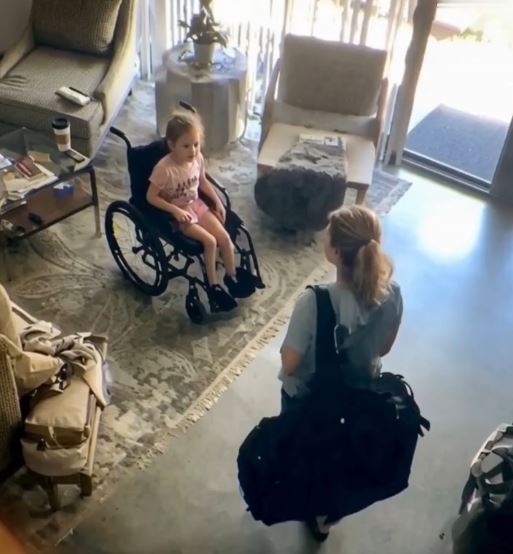
I thought hiring a nanny would finally make life easier for me and my seven-year-old daughter. Instead, one random motion alert at work sent me racing home, because the woman my nanny let into my house was the last person I ever expected to see again.
I hired a nanny because I was out of tricks, out of backup plans, and almost out of nerve.
My daughter, Lisa, is seven, hilarious, stubborn, dramatic, and too smart for my own good. She names her stuffed animals Captain Pancake, Miss Opera, and Mr. Doom, then gives them long speeches before bed.
She is also in a wheelchair.
When she was three, doctors found a rare neurological disorder that kept stealing strength from her legs. First came the tripping, then the falling, then the moments when standing felt impossible. By four, the chair was not temporary anymore for good.
Her father left before the diagnosis, which is a clean sentence for a filthy thing.
Since then, I have worked full-time, argued with insurance during lunch, memorized medication schedules, and spent too many hours in waiting rooms painted with smiling giraffes and chipped rainbows. I know the smell of bad clinic coffee better than I know the smell of sleep.
So when Maya showed up, it felt like someone had cracked open a window.
She was 22, studying pediatric therapy, warm without sounding fake, and somehow perfectly matched to Lisa’s bright, chaotic storms. Lisa trusted her almost immediately.
On her second day, Lisa looked up from a puzzle and asked, “Do you know princesses?”
Maya leaned against the couch and said, “No, but I know dragons.”
Lisa gasped like she had finally met a serious person. “Even better.”
After that, Maya was in.
She helped with stretches, made games out of boring exercises, and never once talked to Lisa in that syrupy voice adults use when they are trying too hard to seem kind. For the first time in years, I let myself imagine a life that was hard, yes, but not constantly one hour away from collapse.
Then Thursday happened.
I was at work, staring at a spreadsheet, pretending numbers mattered more than rent, medication copays, and the stack of forms waiting on my counter.
My phone buzzed with a motion alert from the nanny cam in the room.
Usually I ignored those. Usually it was Maya helping Lisa with a puzzle, or Lisa trying to feed crackers to a stuffed penguin that had never asked for them.
But something in me pulled tight.
I opened the app.
The video loaded.
Maya walked to the door, glanced over her shoulder, unlocked it, and waved her inside.
The second I saw her face, I stopped breathing.
Sarah.
My middle school bully.
The girl who mocked my clothes loud enough for people to laugh with her. The girl who dumped my backpack into a toilet and grinned while I tried not to cry. The girl who made school feel so dangerous that I used to get sick before first period.
I had not seen her in more than 15 years.
Now she was walking into my house with a duffel bag that scared me on sight. Then she pulled metal from it and moved toward Lisa.
I ran.
I called 911 from the parking lot and broke every speed limit on the way home.
I hit the door so hard it slammed against the wall.
“Get away from her!”
Maya spun around, white faced and shaking.
Then I saw Sarah on her knees in front of Lisa’s chair, and my anger stumbled over confusion.
She was not hurting her. She was fastening a support frame along the sides of the seat and lower back, sleek and padded, with straps, brackets, and careful adjustments that looked exact to be random.
It looked expensive. It looked custom. It looked like planning.
I still saw red.
“What is wrong with you?” I shouted at Maya. “Who is this, and why is she in my house?”
Maya burst into tears so fast it almost made me angrier.
“I can explain.”
“No. You can pack your things and leave.”
Sarah stood slowly and lifted hands.
“You have every right to be furious.”
“Don’t talk to me like we know each other.”
“We don’t. Not really,” she said.
Lisa looked from one face to the other.
“Mom?”
I dropped beside her chair so my knees hit the rug.
“Baby, are you okay? Did anyone hurt you?”
Lisa blinked.
“No.”
I checked her anyway, hands shaking against her shoulders, her arms, the blanket across her lap.
“Did they do anything without asking?”
“I only adjusted the support under her hips and lower spine,” Sarah said. “Nothing painful.”
“I wasn’t asking you. I can say from experioence that you’d never do anything to help someone else.”
I stood and pointed at the door.
“Out. Now.”
Then Maya spoke in a small, broken voice.
“I called her because I thought she could help Lisa. I’m so sorry. She’s my mom’s best friend, and I knew she could help.”
I turned on her.
“You what?”
“Please just first hear me out.”
“You do not bring strangers into my home and then ask me to breathe through it.”
Maya wiped her face with both hands.
“I found research on Lisa’s condition. Conference materials. Mobility work. Sarah’s name was on it, so I reached out because I wanted information.”
I stared at Sarah and felt sick.
“You?”
She nodded once.
Maya rushed on before I could say more.
“I told her about the fatigue, the pain during transfers, the alignment problems. I said Lisa’s mom was handling everything alone. I said your name.”
Sarah met my eyes.
“The second Maya said your name, I knew who you were.”
My body went cold.
“And you came here?”
“I almost did not.”
That lit the fuse again.
“How generous.”
She took that without flinching.
“I deserved it.”
Lisa tugged my sleeve.
“Mom?”
I forced my voice softer.
“I’m here, baby.”
She touched the side of the frame.
“My back feels better.”
Everything in the room stopped.
I stared at her.
“What?”
“I do not feel twisty.”
Against my will, I looked at Sarah.
She answered carefully, as if any word would end the conversation for good.
“Her posture has been forcing her body to compensate all day. This redistributes pressure and stabilizes her pelvis. It should reduce fatigue.”
“You do not get to throw medical words at me and expect trust.”
“I do not expect trust.”
Maya stepped forward, miserable and stubborn at once.
“She has built devices for kids like Lisa.”
I turned on her.
“And you decided that meant you could keep secrets about my daughter?”
Her face crumpled.
“I was desperate. Sarah explained everything and asked me to keep things quiet.”
“So was I. I still did not invite strangers into my house.”
Sarah’s jaw tightened, but her tone stayed level.
“I should have refused to come. But Maya described symptoms I recognized immediately. Lisa is the kind of patient I design equipment for.”
I crossed my arms.
“Working where?”
A beat passed.
“Nowhere official,” Sarah said.
I laughed once.
“That is not comforting.”
Maya looked miserable.
“She lost her job after a fight with administration. Not because a child got hurt.”
Sarah shot her a look.
“I can speak for myself.”
“Then speak,” I said.
She met my eyes.
“I broke protocol on a pediatric case because I believed the standard plan was failing the patient. I was told to stop. I did not. I lost my position, and my reputation went with it.”
Lisa whispered quietly, “Can I please try it now?”
I crouched beside her again.
“Try what?”
“The standing thing,” she said. “She told me there might be a way to help me stand.”
I looked at Sarah so hard she took a step back.
“You promised my child what?”
“I promised nothing,” she said. “I said there was a device that might support a standing transfer.”
Lisa’s eyes were huge. Hopeful, careful, apologetic for wanting too much. She had spent years learning not to hope loudly in offices.
Then Sarah’s voice changed. It got softer, rougher, stripped to the bone. No cure. No miracle. That was all she meant.
Then she looked at me, not Lisa.
“If you want me gone, I will leave.”
I swallowed hard.
“Why, Sarah?”
She knew what I meant.
Her face went still.
“Because I was awful to you. Not careless. Not kid cruelty. I was cruel on purpose. I’m not that person anymore. Ever since my son was born with a congenital defect, and I discovered how big of an impact I could have on someone else’s life, I’ve tried to help others.”
Maya said nothing.
Sarah kept going.
“My home was chaos. I was angry the time. I picked people I thought were safe to hurt, and you were one of them. I have thought about that for years. When Maya said your name, I wanted to hang up. Then she talking about Lisa, and I came.”
This situation was completely new territory for me.
“You do not get redemption through my daughter.”
Her eyes filled with tears, but she nodded.
“I know.”
Lisa whispered, “Mom, please.”
I closed my eyes.
When I opened them, I said, “One try. I stay here. If I say stop, you stop.”
Sarah nodded at once.
“Yes.”
She and Maya positioned the braces while Sarah explained step before she touched anything.
“Feet here. Knees lined up. Hips supported. Lisa, hold the bars. Good. Breathe.”
I stayed close to catch her if anything slipped.
Lisa gritted her teeth.
“I’m trying.”
“I know,” Sarah said. “Again. Push through your arms.”
At first, nothing happened.
My heart sank so hard it almost hurt.
Then Sarah adjusted one strap by half an inch and said, “Okay. Now.”
Lisa pushed.
The braces locked.
Her body lifted.
Not all the way. Not gracefully. Not for long.
But she rose.
My daughter rose.
Her eyes went wide.
“Mom.”
I covered my mouth because the sound that came out of me was not a word.
Lisa laughed and cried at the same time.
“Mom, I’m standing. Look.”
“I see you,” I said, and my voice broke clean in two. “I see you.”
It lasted four seconds.
Then she dropped back into the chair, trembling and exhausted.
Sarah knelt at once.
“That was enough. More than enough. We do not push past fatigue.”
Lisa was breathless, grinning so hard her cheeks shook.
“Did you see?”
“I saw,” I said, crying so hard I could barely get the words out.
Maya was in the kitchen, crying into both hands, by the time I sat across from Sarah at the table.
I told her what she had done to me back then. The panic attacks. The transfer. The way I still sometimes assume laughter in room is about me.
She listened.
No excuses. No speech about being young. No request for understanding.
Just, “I know,” and, “I’m sorry.”
I did not forgive her. I still have not. Not fully.
But I told her the rules.
“You do nothing for Lisa unless I know first. Her doctors get everything. Everything gets documented. No secrets. Ever again.”
Sarah nodded.
Maya whispered, “I’m so sorry.”
I looked at her for a moment.
“You do not get to do this again.”
“I know.”
That was three months ago.
Lisa is still in her wheelchair.
There is no magic ending. No field. No running.
But now she can do supported standing for almost a minute on good days. Transfers hurt less. Her posture is better. She gets less tired sitting upright. She smiles more during therapy.
Sarah comes, works, explains, and leaves. She never asks me to ease the past.
Once, Lisa asked why Sarah looked nervous around me.
I said, “Because she hurt me a long time ago.”
Lisa thought, then said, “Is she trying to help now?”
“Yes.”
She nodded.
“Then maybe she changed.”
Tonight Lisa balanced for six seconds. It wasn’t long, but it was long enough that both of us had to fight back tears as we laughed and celebrated.
This work is inspired by real events and people, but it has been fictionalized for creative purposes. Names, characters, and details have been changed to protect privacy and enhance the narrative. Any resemblance to actual persons, living or dead, or actual events is purely coincidental and not intended by the author.
The author and publisher make no claims to the accuracy of events or the portrayal of characters and are not liable for any misinterpretation. This story is provided “as is,” and any opinions expressed are those of the characters and do not reflect the views of the author or publisher.