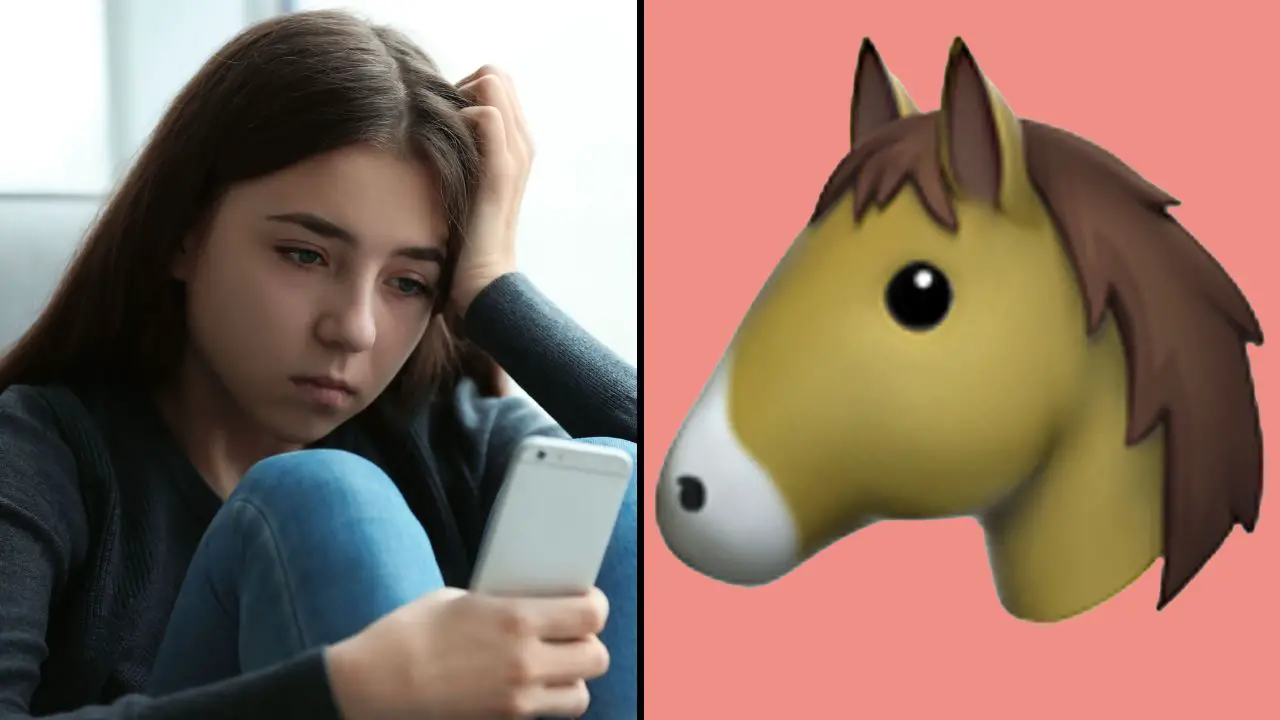
Police are warning parents to look out for children using a horse emoji on their phones, as there could be a sinister meaning behind it.
Having a child in the ever-evolving 21st century can feel daunting, with technology advancing rapidly and the world at one’s fingertips with just a few taps on a screen.
The internet allows us to reach, connect, and consume content at incredible speeds, bringing plenty of benefits. From keeping in touch with friends and family to learning new skills online, digital technology has transformed everyday life.
But alongside these positives come new challenges for parents.
Young people are growing up in a digital world where trends, slang, and online communities change almost overnight. As children and teenagers are often curious, impressionable, and eager to fit in, they can be more vulnerable to harmful influences or risky behavior online.
Police have recently warned parents to keep an eye out for certain emojis that may carry hidden meanings – the horse emoji, for example.
While many children will simply use emojis in innocent ways, the warning highlights how online communication can sometimes mask more serious conversations.
For parents, the message isn’t to panic, but to stay informed.
The hidden language behind everyday emojis
Many parents only became aware of the hidden meanings behind certain emojis after watching the recent Netflix hit Adolescence.
The psychological British crime drama is centered on a 13-year-old schoolboy who is arrested after the murder of a girl in his school.
The show sparked widespread conversation online, with viewers shocked to learn that everyday symbols used in text messages can sometimes carry coded meanings among young people.

After the series aired, parents across social media admitted they had started looking more closely at the emojis appearing in their children’s messages and posts.
For some, it was the first time they realized that what appears to be harmless digital shorthand could occasionally hide references to risky behavior or online trends.
In Adolescence, emojis are used among children as code words, revealing that many of the text icons older generations believe are harmless actually can have an entirely different meaning.
Don’t panic: emojis don’t always mean trouble
When keeping an eye on digital conversations for these emojis, it’s important to consider the context in which they are used.
Seeing a particular symbol doesn’t automatically mean a conversation is harmful or suspicious. Instead, the meaning often depends on how and where it appears in a message.

Being aware that some emojis can have hidden meanings can be useful for parents, but they are only one piece of the puzzle.
Looking at them alongside other signs of potential risk or changes in behavior can give a clearer picture of whether there is something to be concerned about.
The hidden meaning behind emoji symbols
In Adolescence, the key storyline reveals that the suspected killer, Jamie Miller, has been radicalized by misogynistic material online that promotes hostile and s**ist attitudes towards women.
Among the most extreme communities linked to this ideology are so-called ‘incels’ – short for ‘involuntary celibates’ – men who define themselves by their perceived inability to form s**ual relationships with women.
Because much of this movement exists online, emojis have sometimes been adopted by members of these communities as subtle signals of their beliefs. In some cases, the symbols are also used by critics to label someone as an incel.
One of the most notable examples is the pill emoji, which can be used to suggest whether someone shares incel ideology.
In an article for The Conversation, Dr. Robert Lawson, a sociolinguistics expert at Birmingham City University, explained: “The cyberpunk blockbuster The Matrix is the source of a key symbol in the manosphere – the red pill.”

Just as in The Matrix, influencers within the so-called manosphere describe embracing misogynistic views as ‘taking the red pill’ – a metaphor for supposedly waking up from the ‘Matrix’ of mainstream beliefs.
Dr. Lawson continues: “In the manosphere, those who have been ‘red-pilled’ see the world as it really is, understanding the so-called ‘real’ nature of women’s behaviour and dating preferences.
In Adolescence, DI Bascome – played by Ashley Walters – is told that the dynamite emoji can represent an ‘exploding red pill,’ used to signal that someone identifies as an incel.
It’s also explained that the ‘100’ emoji is another symbol connected to incel beliefs, referencing what is known as the ’80/20 rule.’
The suspected teen killer in the show tells his father: “80 per cent of women are attracted to 20 per cent of men. Women, you must trick them because you’ll never get them in a normal way.”
The series also highlights how even something as simple as a heart emoji can carry multiple meanings depending on its color.

“Red means love, purple h**ny, yellow ‘I’m interested, are you interested?’, pink ‘I’m interested but not in s**,’ orange ‘you’re going to be fine,’ it all has a meaning – everything has a meaning,” the teen also tells his father.
However, this is just one interpretation of heart emoji slang, and meanings can vary widely across different online communities.
Yet there is one area that the show does not explore regarding emojis – how they can be used to refer to or facilitate the sale of illegal drugs.
What police want parents to know about emoji codes
In 2023, Surrey Police in the UK released guidance aimed at helping parents understand the latest emoji slang.
According to the guide, certain emojis can sometimes be used as coded references to specific substances.
For instance, a horse emoji may be used to indicate k***mine, a drug that is also commonly used in veterinary medicine to anaesthetize horses.
Other symbols can also carry hidden meanings. Emojis such as an alien, a demon mask, a space invader, or skull and crossbones may be used to refer to M**A.
The guide also explains that coc***e is often represented through emojis linked to its well-known nicknames. Someone might use a snowflake or snowman to represent ‘snow,’ while a blowfish emoji could refer to ‘blow.’
C**nabis, meanwhile, can be signaled by a surprisingly wide range of emojis.
These may include symbols such as dogs, cake, ice cream, lemons, and purple grapes, as well as more obvious references like a maple leaf, four-leaf clover, or tree and leaf emojis.
Another commonly used symbol is the plug emoji, which can be used to refer to a drug dealer – often called ‘a plug.’

A statement from Surrey Police said: “What is vital in these discussions is trust.
“We’re very aware that checking phones could break down this trust between a parent and their child, and therefore we are not suggesting parents do this.
“Instead, we want people to be aware of what these emoji mean, in case they do happen to see them.”