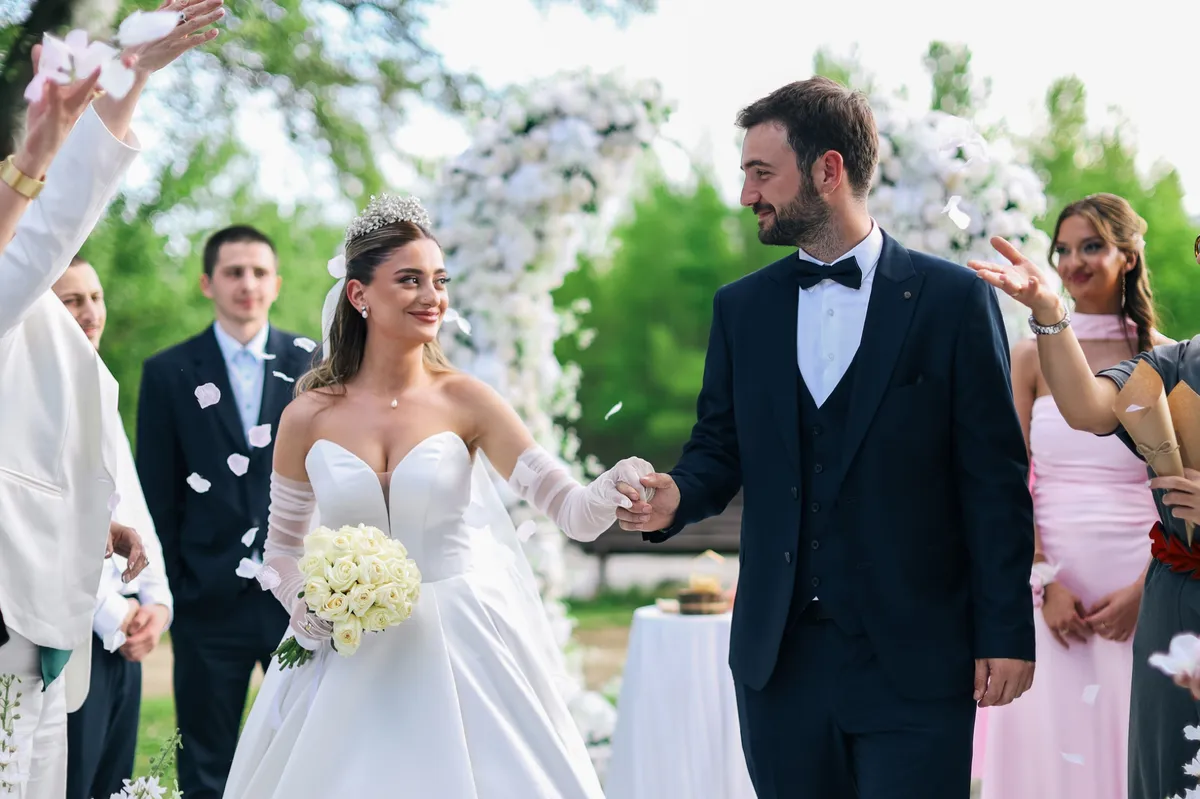
I thought my father had taken all our family secrets to his grave. Then, on my wedding day, my sister revealed she’d been hiding something from me for fifteen years because Dad had made her promise.
Brooke opened the package.
The first thing that fell out was a wedding ring.
Not Dad’s.
A woman’s.
It was a simple gold band wrapped in tissue paper, with a tiny diamond set into it.
I stared at it.
Then something else slid onto the table.
A photograph.
Brooke picked it up.
Her knees seemed to give for a second, and she grabbed the back of a chair.
“Brooke?”
She didn’t answer.
I took the picture from her.
There were four people in it.
Dad looked maybe 30.
He was wearing jeans and a flight jacket, smiling in a way I barely remembered.
Beside him stood a woman with long brown hair.
She was holding a baby.
Brooke.
And Dad was holding another baby.
Me.
I had seen only two photographs of our mother in my entire life.
But I knew immediately.
“That’s her.”
Brooke sat down.
“Yeah.”
My hands started shaking.
On the back, Dad had written, “Our last picture together. All four of us.”
There were also letters.
A lot of them.
Some addressed to Dad.
Some to Brooke.
Some to me.
All in handwriting I didn’t recognize.
The top envelope said, “For my girls, if they ever want to know me.”
I looked at Brooke.
“What is this?”
She shook her head.
“I don’t know.”
“You had this for 15 years.”
“I never opened it.”
“You didn’t even look?”
“Dad made me swear.”
She sounded almost defensive.
Then her face crumpled.
“God, Emma, I wanted to. So many times.”
My name is Emma.
I was 28 when I got married. Brooke was 39.
She had been more than my sister for most of my life.
When Dad died in Afghanistan, I was 13. Brooke was 24.
Old enough to become my guardian.
Young enough that she should have been worrying about her own life instead of mine.
But she didn’t hesitate.
She rearranged everything.
She took assignments she didn’t necessarily want because they kept her closer to the people helping care for me.
Dad’s best friend and his wife let me stay with them during stretches when Brooke had to be away.
Brooke handled school forms.
Doctor appointments.
Parent-teacher meetings.
My first driving lesson.
My first breakup.
The time I got caught sneaking out at sixteen, and she grounded me so aggressively that I shouted, “You’re not my mother!”
She went completely still.
Then said, “No. I’m not.”
I regretted it before she left the room.
She came back ten minutes later and said, “But I’m the person responsible for you, so you’re still grounded.”
That was Brooke.
She could be furious and steady at the same time.
Our mother had always been the blank space in the family.
We knew her name.
Anna.
We knew she had left when we were young.
That was about it.
Brooke remembered slightly more than I did.
A perfume smell.
Someone singing in the kitchen.
A red scarf.
But she wasn’t sure whether those were real memories or things she’d built from old photographs.
Dad never insulted Mom.
That mattered.
Whenever we asked why she left, he gave some version of, “She was struggling with things I didn’t know how to fix.”
Or, “She loved you, but she wasn’t able to be your mother then.”
When I got older, I pushed harder.
“Is she alive?”
Last Dad knew, yes.
“Where?”
He wouldn’t say.
“Does she know where we are?”
He’d go quiet.
Then say, “Emma, some answers have to wait until you’re older.”
I hated that answer.
Then he died.
After that, Mom stopped being a question I asked.
I had lost the parent who stayed.
I didn’t have energy for the one who hadn’t.
Until my wedding day.
Brooke and I sat in a small room off the reception hall while everyone else drank champagne and wondered where the bride had disappeared.
My new husband, Colin, knew something was happening.
I told him I needed a few minutes with Brooke.
He kissed my forehead and said, “Take as long as you need.”
Brooke opened the first letter.
It was from Dad.
Dated nine days before his final deployment.
His handwriting looked exactly the way I remembered.
“Brooke, if you’re reading this, I didn’t make it home to explain it myself. I’m sorry.”
I started crying immediately.
Brooke stopped.
“I can read it.”
“No.”
She wiped her face.
“Dad gave it to me. Let me.”
So she continued.
“You know the version of the story I gave you, girls. Your mother left. That part was true. But it was never the whole truth.”
I looked at Brooke.
She was pale.
“Anna became addicted to pain medication after Emma was born.”
My stomach dropped.
I read the sentence over Brooke’s shoulder.
Mom.
Addicted.
Dad continued.
“It started after surgery. By the time I understood how bad it was, she was taking whatever she could find. She disappeared for days. She lied. She stole money. Once she drove with both of you in the car after taking pills. That was the day I stopped allowing her to be alone with you.”
I felt physically sick.
Brooke whispered, “I don’t remember that.”
Neither did I.
Dad’s letter said our mother went to treatment twice.
Left early twice.
Eventually, after another relapse, she disappeared.
Dad filed for custody.
Mom didn’t fight him.
For nearly four years, they barely heard from her.
Then she contacted him.
She was sober.
At least, she said she was.
She wanted to see us.
Dad didn’t allow it immediately.
Instead, they started exchanging letters.
He needed proof that she was stable.
Not weeks. Years.
He wrote,
“I know that may sound cruel. Maybe it was. But I had two little girls who had finally stopped asking whether their mother was coming home every time a car pulled into the driveway. I wasn’t willing to reopen that door because Anna had been sober for six months.”
Brooke put the letter down.
She was crying silently.
I said, “So she came back?”
“Keep reading.”
Dad said Mom remained sober.
One year. Then two. Then three.
She worked. Went to meetings.
Paid back money she’d taken from relatives.
She didn’t show up at our school.
Didn’t call the house. Didn’t force contact.
She sent letters to Dad and asked him to save some for us.
Then, during her fourth year of sobriety, she relapsed.
Only once, according to Dad.
But it scared him. It scared her too.
She went back to treatment voluntarily.
After that, they agreed that no reunion would happen until both Brooke and I were old enough to participate in the decision.
Brooke was furious.
“I was 18.”
Dad addressed that too.
“Brooke, you’re probably angry reading this because I could have told you sooner. You were old enough to know some of it. I kept waiting for the perfect time. There wasn’t one. Then military life kept moving, and every year it became harder to admit how much I had withheld. That was my mistake.”
Brooke pressed her fist to her mouth.
I put my hand on her shoulder.
She kept reading.
“I did not keep Anna from you because I hated her. I kept distance because I did not trust her stability yet, and later because I was afraid of what reopening the relationship might do to both of you. Fear can look a lot like certainty when you’re a parent. I was afraid, so I convinced myself I was sure.”
That sounded like Dad.
Painfully like him.
He hated admitting fear.
The letter said that by the time of his final deployment, Mom had been sober for six years continuously.
Six.
She had a job, an apartment, a sponsor, and a quiet life in Oregon.
Dad had started seriously considering telling us.
Then the deployment came.
So he made the package.
I interrupted.
“Why my wedding?”
Brooke shook her head.
Dad had explained that too.
“Emma is still thirteen. If something happens to me, she will already be losing more than any child should have to lose at once. Do not give her this immediately. Let her grow up.”
I swallowed.
Then,
“I know asking you to wait until her wedding day is strange. Maybe she’ll marry at 20. Maybe 40. Maybe never. If she never marries, give it to her when you believe she’s ready. But if she does marry, I want both of you to open it together that day. Weddings make people ask where they come from and what kind of family they want to build. If there is ever a day she deserves the whole truth, it is that one.”
I covered my face.
Brooke whispered, “I thought about giving it to you when you turned 21.”
I looked at her.
“Why didn’t you?”
“Because I was scared.”
“Of Dad?”
“No.”
Her voice cracked.
“Of losing you.”
I didn’t understand.
Brooke said, “You were all I had left.”
That destroyed me.
She continued.
“What if she was alive? What if you found her and loved her? What if you decided I had helped Dad keep her from you?”
I stared.
“Brooke.”
“I know.”
“No.”
I grabbed her hand.
“You raised me.”
She nodded, crying.
“That’s exactly why I was scared.”
We sat there holding hands in my wedding dress and her military uniform.
Then I noticed one more line in Dad’s letter.
“Brooke, do not make Anna pay forever for who she was at 28. And do not make Emma forgive her just because she changed. Those are two different things.”
That was the line that settled the room.
Dad wasn’t asking us to reunite with her.
He wasn’t asking us to reject her.
He was giving us information.
Then choice.
Finally.
Brooke opened the envelope addressed to us.
Mom’s letter.
The paper was older than Dad’s.
She had written it seven years before his death.
“Dear Brooke and Emma, there is no version of this letter where I can make what I did sound better. I left you.”
I felt my throat close.
“I was sick, but sickness does not erase consequences. Your father protected you when I could not be trusted to protect you. If you grew up angry at me, you had every right. If you grew up not thinking about me at all, I understand that too.”
Brooke was crying openly now.
Mom wrote about treatment.
About shame.
About the first time she saw a photo Dad sent her of us older.
Brooke in a flight jacket.
Me missing my two front teeth.
She said she cried for three days because we’d become children she didn’t know.
Then came the part that hurt most.
“I used to tell myself I stayed away because your father wouldn’t let me come back. That was easier than saying I had given him good reasons not to trust me. Later, when he was finally willing to discuss contact, I became afraid you would reject me. So sometimes I hid behind his caution too. I need you to know that. Your father did not steal you from me. I lost years because of choices I made while I was sick, and then I lost more because I was ashamed.”
I whispered, “She knew.”
Brooke nodded.
At the bottom, Mom had written,
“If you ever read this, and if I’m still alive, you owe me nothing. Not a phone call. Not forgiveness. Not the word Mom. But if you want answers, I will answer honestly.”
There was an address.
A phone number.
Then I noticed the ring again.
There was a smaller note wrapped around it.
“This was my wedding ring. I stopped wearing it after the divorce because I had no right to pretend I was still his wife. But I could never throw it away. If either of you wants it, keep it. If neither of you does, sell it and buy something useful. Your father would approve of that more than sentimentality.”
I laughed through my tears.
Dad absolutely would.
Brooke looked at me.
“What do you want to do?”
“I don’t know.”
And for once, that was enough.
We didn’t make a huge decision in that little room.
I didn’t immediately call the number.
I didn’t put Mom’s ring on.
I put it back in the tissue paper.
Then there was one final envelope.
My name.
Dad’s handwriting.
“Emma — wedding day.”
My hands shook so badly that Brooke opened it for me.
Inside was one page.
“Kiddo, If you’re wearing a wedding dress while reading this, I owe you an apology because I am clearly not there to complain about how much everything cost.”
I laughed so hard I cried harder.
“I wish I could walk you down the aisle. I wish I could meet the person you chose. I wish I could embarrass you in front of everyone.”
I couldn’t read anymore.
Brooke took over.
“Since I can’t, let Brooke stand where I would have stood. She has been looking out for you since before either of you understood what that meant. Don’t let her tell you she only did what she had to do. She chose you every day.”
Brooke stopped.
“No.”
I grabbed her arm.
“Keep reading.”
She wiped her eyes.
“And remember something I learned too late: family is not only the people who stay, and it is not automatically the people who come back. Family is built by what people do with the chances they are given.”
Then:
“Your mother may still be out there. She may not. If you want to find her, find her. If you don’t, don’t. Do not make the decision for me.”
The last line said, “I love both my girls. Save me a dance.”
Brooke couldn’t finish. Neither could I.
Eventually, Colin knocked gently.
“Everything okay?”
I opened the door.
He saw both of us crying.
Then looked alarmed.
“Did someone die?”
Brooke laughed.
“Technically, fifteen years ago.”
“Brooke.”
“What? He did.”
That was such a terrible joke that I started laughing too.
Colin looked completely lost.
I handed him Dad’s letter.
He didn’t read it.
He asked me, “Do you want me to?”
That was one of the reasons I married him.
I said, “Later.”
He nodded.
Then Brooke said, “We’ve been gone almost 40 minutes.”
I looked down at my wedding dress.
“Oh, God.”
My reception.
There were over 100 people outside.
Brooke stood.
“Come on.”
I looked at Dad’s package.
“What do we do with this?”
She held out her hand.
“We keep it safe.”
So we did.
That night, Brooke gave the father-of-the-bride speech.
She hadn’t prepared one because nobody knew she was coming.
It was terrible.
She told people I once crashed Dad’s car into our mailbox at sixteen.
She told Colin he’d better learn to sleep through snoring because apparently I sounded “like a helicopter with mechanical problems.”
Then she got quiet.
She looked at me and said, “Our dad once told me that taking care of somebody and loving somebody aren’t the same thing. You can do one out of duty. The other has to be a choice.”
I started crying again.
Brooke raised her glass.
“Emma, being your sister was never duty.”
That was all she said.
It was enough.
Later, the DJ played one of Dad’s favorite songs.
Brooke found me.
She held out her hand.
“Saved him a dance?”
I nodded.
So we danced.
Two sisters.
One in a wedding dress. One still in uniform because she’d barely had time to change before flying in.
I cried into her shoulder.
She said, “You’re getting makeup on my uniform.”
“Dad would tell you to stop complaining.”
“Dad would send you the dry-cleaning bill.”
Also true.
We laughed.
Six months after the wedding, I found our mother.
The old number didn’t work.
The address belonged to someone else.
Brooke and I almost stopped there.
Then I searched public records and social media.
Eventually, I found a woman with Mom’s full name living in Washington State.
Same age. Same eyes.
I stared at her profile for two days.
Then I sent one message.
“My name is Emma. My father was David. I think you may be my mother.”
She replied 18 minutes later.
I am.
That was it.
No dramatic paragraph. No demands.
Just: I am.
Then another message.
“Is Brooke okay?”
That question made me cry.
We didn’t meet immediately.
But we wrote to each other for months.
Brooke joined later.
Mom answered everything.
Some answers hurt. Some made me angry.
Some made Dad’s choices make more sense.
Some made me wish he’d trusted us sooner.
Mom had been sober for twenty-one years by the time we found her.
She had remarried. No other children.
She worked at a library.
The first time we video-called, nobody knew what to say.
Finally, Mom looked at Brooke and whispered, “You look like your father.”
Brooke started crying.
Then Mom looked at me. “And you look like me.”
I didn’t know whether I wanted to hear that.
Eventually, I decided I did.
We met in person the following Christmas.
Not at my house. Not hers.
Neutral ground.
A restaurant.
Two hours. That was all we promised.
It lasted four.
I didn’t call her Mom.
Not then.
Sometimes I still don’t.
Her name is Anna in my phone.
Our relationship is not a movie ending.
When people hear the story, they sometimes focus on our mother.
They ask whether I forgave her.
I don’t know if forgiveness is one decision.
I think ours has been hundreds of smaller ones.
Answering another message.
Asking another question.
Letting her send a birthday card.
Believing an apology without pretending the past disappeared.
But the part I remember most about my wedding isn’t discovering that our mother was still alive.
It’s Dad’s line about Brooke.
She chose you every day.
Would you have forgiven Brooke for keeping the package secret for fifteen years, or would you have felt betrayed despite everything she sacrificed to raise Emma?