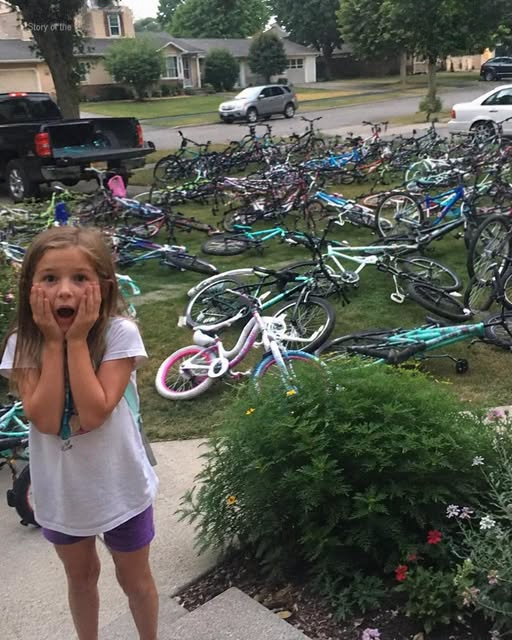
I woke up on a quiet Sunday morning to find our front yard covered in something that hadn’t been there the night before. When I saw who was standing in the middle of it all, I knew there was a story I hadn’t been told.
“You need to see this.”
My husband shook my shoulder hard enough to wake me.
I squinted at the clock.
It was 7:00 A.M. on Sunday.
“What happened?”
“Just look outside.”
The urgency in his voice made me sit up.
I hurried to the bedroom window, pulled back the curtain, and stared.
“What the…”
Our front yard was covered in bicycles.
There weren’t five or six.
There were dozens.
Little bikes with training wheels, old mountain bikes, beach cruisers, and rusty bicycles that looked as though they hadn’t moved in years covered the grass.
Some leaned against our porch.
Others stood in rows across the yard.
One was even lying beside our mailbox.
And standing right in the middle of them was our 74-year-old neighbor, Walter.
He looked up at our bedroom window and waved.
I turned slowly toward my husband.
“Why is Walter standing in our yard?”
My husband rubbed the back of his neck.
“There’s something I forgot to tell you.”
That was never a promising start.
“What did you do?”
“Nothing.”
I pointed toward the window.
“There are about 50 bicycles on our lawn.”
“I know.”
“You know?”
“Technically, I told Walter he could use part of the yard.”
I stared at him.
“Part of the yard?”
“He said he needed some space.”
“For what, a bicycle dealership?”
“I thought he meant two or three.”
I looked outside again.
A car had just pulled up, and a woman opened the back of a minivan and began unloading more bicycles.
“Well, there’s number 51.”
My husband winced.
Twenty-four hours earlier, there hadn’t been a single bicycle on our lawn.
The only reason Walter was involved at all was because of our eight-year-old daughter, Molly.
Walter lived alone across the street.
He was quiet but kind, and Molly had never met an adult she couldn’t turn into a conversation partner.
If Walter was checking his mailbox, Molly talked to him.
If he was watering his plants, she talked to him.
A few weeks earlier, Molly had noticed something.
Walter often watched while she and the neighborhood kids rode their bikes.
He never interrupted them.
He simply stood in his driveway or sat on his porch and watched them race up and down the street.
One afternoon, Molly stopped in front of him.
“Did you have a bike when you were little?”
Walter smiled.
“More bikes than you can imagine.”
Molly’s eyes widened.
“More than me?”
“Definitely more than you.”
I heard the conversation from our porch, but I didn’t think anything of it.
Then, on Saturday afternoon, I looked outside and saw Molly pushing her old red bicycle toward the street.
“Molly!”
She stopped.
“Where are you taking that?”
“Across the street.”
“Why?”
“To Walter.”
That surprised me.
Molly had recently outgrown the little red bicycle, but she had refused every suggestion that we donate it.
She had learned to ride on that bike.
It had scratches along the frame, worn handlebar grips, and a bell that only worked when it felt like it.
The brakes weren’t much better.
Still, Molly loved it.
“You wouldn’t let us give that bike away,” I reminded her.
“I know.”
“But now you’re giving it to Walter?”
“Yes.”
“Why?”
She looked at me as though the answer were obvious.
“His garage is too empty.”
I blinked.
“What?”
Apparently, during one of their conversations, Walter had mentioned that his garage felt “too empty” these days.
Molly had decided that meant he needed something to put in it.
Specifically, her bicycle.
“Are you sure?” I asked.
She nodded.
“He can have it.”
I followed her across the street.
Molly knocked on Walter’s door while I waited near the driveway.
When he opened it, his gaze immediately dropped to the bicycle.
“What’s this?”
Molly pushed it toward him.
“You can have mine. The brakes are kind of bad, though.”
Walter didn’t answer.
He stared at that little red bicycle for so long that I wondered whether Molly had somehow upset him.
“Walter?” I said.
He blinked.
Then he crouched beside the bike and ran his fingers over the chain.
“You want me to fix it?”
Molly shrugged.
“If you want.”
Something changed in Walter’s expression.
I couldn’t explain it, but his eyes seemed brighter.
There was something almost painful in them, too.
He stood and took the handlebars.
“Alright.”
Molly smiled.
“Now your garage won’t be empty.”
Walter looked at her.
“No. I suppose it won’t.”
We went home, and I assumed that was the end of it.
I was wrong.
That evening, Walter knocked on our front door.
My husband answered.
I was upstairs helping Molly get ready for bed, so I didn’t hear their conversation.
Apparently, it never occurred to my husband that I might need to know what they had agreed to.
“So, when exactly did Walter ask to use our lawn?” I demanded the next morning.
“Last night.”
“And you forgot to tell me?”
“I didn’t forget.”
I raised an eyebrow.
He sighed.
“Fine. I forgot.”
Outside, another vehicle stopped.
A man climbed out and unloaded two bicycles.
“How many people are coming?”
“I don’t know.”
“You didn’t ask?”
“Walter said he wanted to borrow part of the lawn for a few bikes.”
“A few?”
My husband looked out the window.
“He may have underestimated.”
By 8:00 A.M., people were still arriving.
At that point, curiosity finally beat irritation.
I got dressed and went outside, with Molly running behind me.
The moment she saw the yard, she stopped.
“Whoa.”
“That’s one word for it.”
There were bicycles everywhere.
A woman was unloading four from a minivan.
A man had brought two old mountain bikes.
Someone else had left a tiny purple bicycle with training wheels near the porch.
Molly turned in a slow circle.
“Are these all Walter’s?”
“That’s what I’d like to know.”
Walter was crouched beside an old bicycle, examining one of the tires.
“Walter?”
He looked up.
“Morning.”
“Good morning.”
I glanced around.
“Would you mind telling me why my yard looks like every bicycle in town came here overnight?”
He stood.
For a moment, he looked almost embarrassed.
Then he smiled.
“I may have underestimated this neighborhood.”
“Underestimated it for what?”
Before he could answer, another car pulled up.
The driver lowered the window.
“Walter?”
Walter raised his hand.
“Right here.”
“We’ve got three for you.”
“Anywhere you can find room.”
I stared at him.
“Three more?”
“Apparently.”
Molly tugged on my sleeve.
“Mom, look!”
She was pointing across the street.
Walter disappeared into his open garage.
When he came back out, he was wheeling a little red bicycle beside him.
Molly’s bicycle.
Except it didn’t look like the bike she had pushed across the street the day before.
The tires looked new.
The chain was clean, and the brakes had been repaired.
Even the scratched little bell worked when Walter pressed it.
Molly’s mouth fell open.
“You fixed it!”
Walter smiled.
“Couldn’t sleep.”
She ran over and inspected it.
“You fixed the bell!”
“I did.”
“And the brakes?”
“Those too.”
She spun one wheel, and it turned smoothly.
Then her excitement faded into confusion.
“I thought I gave that to you.”
Walter rested one hand on the handlebars.
“You did.”
Molly frowned.
“Then why did you fix it?”
Walter looked over the sea of bicycles covering our lawn.
By then, even more people were walking toward us carrying old bikes.
Walter pointed toward them.
“And look what I traded it for.”
Molly stared at the bicycles.
I stared at Walter.
I still had no idea what he meant.
But one thing was clear.
Whatever Molly had started by pushing that little red bicycle across the street meant far more to Walter than any of us understood.
“What do you mean, you traded it for all these?”
Molly looked from Walter to the bicycles.
Walter chuckled.
“Not exactly traded.”
“Then why are they here?”
He looked around our yard, and his smile softened.
“Because of your bike.”
That made even less sense.
“Walter,” I said, “maybe you should start from the beginning.”
He nodded and looked at Molly’s red bicycle.
“I used to fix bikes.”
Molly tilted her head.
“As a job?”
“Sort of.”
Walter explained that he had repaired bicycles as a side job for almost 30 years.
Whenever neighbors needed a tire replaced, brakes adjusted, or a chain repaired, they brought their bikes to him.
But that wasn’t all he did.
“Every spring, my wife and I used to collect old bicycles,” he said.
His voice changed when he mentioned her.
“We’d ask around. Friends, neighbors, anybody who had a bike sitting in a garage that their kids had outgrown.”
“What did you do with them?” Molly asked.
“Fixed them.”
“All of them?”
“As many as we could.”
Then Walter and his wife gave the repaired bicycles to local children who needed them.
Some years, they repaired only a handful.
Other years, his garage became so crowded that he could barely walk through it.
“My wife handled the people,” he explained. “I handled the tools.”
I smiled.
“That sounds like a good arrangement.”
“It was.”
His smile disappeared.
“She died three years ago.”
Molly grew quiet.
Walter looked toward his house.
“After that, I stopped.”
He hadn’t repaired a bicycle since.
His tools remained in the garage, and the workbench gathered dust.
Without his wife finding old bicycles, organizing everything, and talking to families, Walter couldn’t bring himself to continue.
“It wasn’t the same,” he said simply.
Suddenly, I understood why he watched Molly and the other children riding through the neighborhood.
I understood why he’d stared at her little red bicycle when she offered it to him.
Molly touched the red handlebars.
“That’s why your garage was empty?”
Walter nodded.
“That’s part of it.”
“So, my bike made you want to fix bikes again?”
He smiled.
“Your bike reminded me that I still could.”
After Molly went home on Saturday, Walter had taken the bicycle into his garage.
At first, he intended to fix only the brakes.
Then he noticed the worn tires.
After replacing those, he cleaned the chain and repaired the bell.
Before he knew it, he was standing at his old workbench, surrounded by tools he hadn’t touched in three years.
“It felt good,” he admitted.
When he finished, he took a photograph of Molly’s newly repaired bike.
Then he did something he hadn’t planned.
He posted the photograph in a neighborhood Facebook group.
Walter wrote that he was thinking about repairing donated bicycles again.
If anyone had an old bike taking up space, he said, he might be able to give it another life.
He expected maybe five.
“How many people answered?” I asked.
Walter glanced at our lawn.
“More than 60.”
I laughed.
“So that’s why you asked to borrow our yard.”
“My garage wasn’t going to hold all of them.”
My husband walked over.
“In my defense, he didn’t say 60.”
“I didn’t know there would be 60,” Walter replied.
Molly stared around the yard.
“You’re going to fix all of these?”
Walter rubbed his chin.
“I’m going to try.”
“By yourself?”
That question stopped him.
For the first time that morning, he looked slightly overwhelmed.
There were rusted chains, flat tires, torn seats, and bent handlebars everywhere.
Then the woman who had brought four bicycles from her minivan approached us.
“I saw your post last night,” she told Walter. “My husband knows his way around bikes. If you need another pair of hands, he’d probably help.”
A man standing nearby overheard her.
“I can help with tires.”
Walter blinked.
Someone else offered spare parts, while another neighbor said he had tools Walter could use.
Within minutes, the pile of old bicycles started turning into something else.
It wasn’t just Walter’s project anymore.
Molly tugged on his sleeve.
“Can I help?”
He looked down at her.
“Do you know how to fix a bike?”
“No.”
“Then I guess I’ll have to teach you.”
She grinned.
“What do I do first?”
Walter pointed toward a dirty bicycle nearby.
“You can start by cleaning that one.”
Molly immediately ran toward it.
I watched Walter follow her.
The quiet man I’d seen sitting across the street for years suddenly seemed different.
He was giving instructions, checking tires, opening boxes of tools, and laughing with people around him.
By lunchtime, part of our driveway had become a makeshift repair station.
My husband brought out folding chairs, and I made sandwiches.
Molly spent most of the morning beside Walter, asking so many questions that I apologized twice.
Walter waved me off.
“She asks good questions.”
At one point, I saw him show her how a bicycle chain fit back onto its gears.
Molly listened as though he were teaching her the most important lesson in the world.
Then she asked, “Did your wife know how to fix bikes, too?”
Walter smiled.
“She knew enough.”
“Was she better than you?”
“At telling me what I was doing wrong? Absolutely.”
Molly laughed.
So did Walter.
For a second, though, I saw him glance toward his empty house.
I wondered how long it had been since his yard had been filled with voices.
How long had it been since someone had stood beside his workbench asking questions?
How long had it been since fixing a bicycle felt like something worth doing?
Late that afternoon, most of the donated bikes had been moved into garages and sheds until Walter could get to them.
Our lawn finally began to reappear.
Molly’s red bicycle remained near the porch.
“Are you giving it away?” she asked Walter.
He shook his head.
“No.”
“But I gave it to you.”
“You did.”
“So, it’s yours.”
“That’s right.”
She frowned.
“Then what are you going to do with it?”
Walter looked at the little bicycle.
“I think I’ll keep this one.”
“Why?”
He rested his hand on the seat.
“Because this one’s special.”
Molly smiled.
I had to look away for a moment.
Over the following weeks, bicycles began appearing outside Walter’s garage in smaller numbers.
More importantly, repaired ones began disappearing.
A little boy left pushing a blue bike that looked almost new.
A girl rode away on a purple one with a basket.
Every time one disappeared, Walter seemed to stand a little taller.
Molly became his unofficial assistant.
She cleaned frames, sorted tools, and tested bells with enough enthusiasm to drive the rest of us crazy.
One afternoon, I stood in Walter’s driveway while he adjusted a set of brakes.
“I hope you know what you’ve gotten yourself into,” I teased.
He looked toward Molly, who was polishing a bicycle nearby.
“I do.”
Then he glanced inside his garage.
Molly’s little red bicycle was hanging carefully on the wall.
“You know,” I said, “she almost let us donate that months ago.”
Walter smiled.
“Glad she didn’t.”
“So am I.”
I finally understood what he’d meant that Sunday morning.
Molly thought she was giving Walter an old bicycle because his garage seemed empty.
She hadn’t known about the 30 years he had spent fixing bikes beside his wife.
She hadn’t known that, after losing her, he had closed his toolbox and walked away from something he loved.
Molly simply saw an empty garage and a lonely neighbor.
So, she gave him something she loved.
Walter repaired that little red bicycle in one night.
But in the process, something in him started working again, too.
He had looked at Molly’s single red bicycle and then at everything her small act had set in motion.
She had given him something she had outgrown without knowing she was returning something he had lost.
His tools were out again.
His garage was full again.
Children were waiting for bikes again.
And for the first time in three years, Walter had a reason to open that garage door and keep it open.
But here is the real question: Can one small act of kindness bring someone back to a part of themselves they thought they had lost forever, without the person offering it ever realizing how much their gesture truly meant?