I always thought my mother survived my father by staying small. Then the night he tried to erase her from our house, I found out she had been quietly preparing for years.
I grew up thinking my mother was weak.
Carol never raised her voice. When things got ugly in our house, she would put on her green coat, take the car, disappear for an hour, and come back composed. As a kid, I thought that meant she gave in. Later, I thought it meant she was afraid.
I was wrong.
That was the official story.
My parents had been married for thirty years. Three kids. One house. My mother painted every room in that house herself. She planted the garden. She paid bills quietly, fixed things quietly, suffered quietly. My father, Raymond, liked to act like he built everything.
He worked late all the time.
That was the official story.
The actual story was women.
I handed the recorder to my mother the next day.
I knew he was cheating long before anything exploded. I heard late-night calls through thin walls. I saw messages flash across his phone. Once, when I was angry enough, I recorded him talking to one of his mistresses.
I handed the recorder to my mother the next day.
“Here. Now you can’t pretend you don’t know.”
She looked at me, then at the recorder. “I don’t need to see this.”
“Then why won’t you acknowledge it?”
Then one night he got careless.
Without another word, my mom took it, and put it in a drawer. By the next morning, it was gone.
I thought she had thrown it away.
I was furious with her for days. Maybe weeks. I remember telling my sister, “She’d rather be humiliated than alone.” I believed that. I really did.
Then one night he got careless.
“Carol, let’s not do drama.”
I won’t get into all of it, but he was caught in a way he could not talk around. No “you’re imagining things.” No “it isn’t what it looks like.” He came home and found my mother waiting at the kitchen table.
I was in the hallway. My brother was upstairs pretending not to listen while keeping my sister on speakerphone. Those two always stuck together when something like this happened.
Dad walked in and tried his usual voice. “Carol, let’s not do drama.”
Mom folded her hands. “Alright. I think we’re done.”
The next morning, without telling any of us first, she filed.
He laughed once. “Done?”
“Yes.”
“You don’t mean that.”
“I do.”
The next morning, without telling any of us first, she filed.
I learned that only later. At the time, all I knew was that something had shifted. She was too quiet, too sure of herself.
There was a bonfire in the middle of the yard.
That evening, I smelled smoke.
There was a bonfire in the middle of the yard.
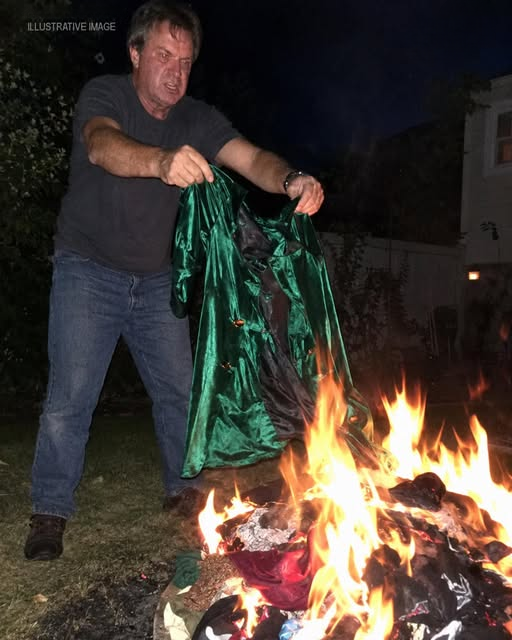
My father stood beside it, throwing in armfuls of my mother’s clothes.
I ran down the stairs. “What are you doing?”
“Cleaning up.”
Then I saw what else was burning. Her silk blouse, which she had been saving for my sister’s graduation. Shoes. Scarves. A cardigan my grandmother made before she died.
Then he held up her wedding dress.
Then he picked up the wedding dress.
I screamed, “Stop!”
He looked at me with a wild look in his eyes. “She filed for divorce. That means she thinks she walks away with what’s hers.”
I pointed at the flames. “That is hers.”
He gave a cold, little laugh. “No. Everything in this house is mine. She came into my life with nothing, and she’ll leave the same way.”
Then he held up her wedding dress. A husband throwing away the dress that should have reminded him of one of the happiest days of his life.
Behind me, the back door opened.
It seemed like he was going full scorched earth. He was going after everything. I wondered where my mom’s favourite green coat was when I rushed toward him. He stepped back and threw the dress into the fire.
Behind me, the back door opened.
My mother stood on the porch.
Her hands were trembling. I turned to her and said, “Mom, say something.”
She looked at the fire. Then at him.
The next morning a package arrived addressed to my mother.
“Okay,” she said. “That’s okay.”
That night I tore through the house looking for the recorder I had given her. I checked drawers, closets, the garage, even the old sewing cabinet.
Nothing.
I barely slept.
The next morning a package arrived addressed to my mother.
He grabbed his phone and dialed my mother with shaking fingers.
My father opened it anyway.
He was at the kitchen counter when I walked in. He pulled out a stack of papers, then froze. The color drained out of his face.
“What the…”
I stepped closer. He tried to shut the box, but I had already seen a recorder. Papers. An envelope.
He grabbed his phone and dialed my mother with shaking fingers.
When she answered, his voice came out wrecked.
I had never heard that tone from him.
“Carol. Please.”
I had never heard that tone from him.
He swallowed hard. “Don’t send this to the firm. Don’t send it to the lawyer. I’ll fix everything.”
That made it click. He wasn’t afraid of being embarrassed. He was afraid of consequences.
He listened for a second. “Carol, please.”
She hung up.
Then my mother walked in through the front door.
I said, “What’s in the box?”
He snapped, “Nothing you need to see.”
Then my mother walked in through the front door.
He turned on her. “You are out of your mind!”
She set her keys down. “Am I?”
“What do you want?”
She looked at him for a while before saying, “For you to understand the difference between being quiet and being helpless.”
Inside the box was the recorder I had given her years ago.
Then she turned to me.
“You should see it.”
Inside the box was the recorder I had given her years ago.
A little paper tag was tied to it in her handwriting.
Plan B.
“You kept it?”
I picked up one transcript.
“Of course I did.”
Under it were more recorders, labeled by year. And transcripts. The worst parts highlighted.
My father made a sharp sound in the back of his throat. “Those are private.”
My mother didn’t even look at him. “The originals are with my lawyer. These are copies.”
That explained his panic.
I picked up one transcript.
I wish I hadn’t.
Then I found the letter.
It was him on the phone with women. It was him mocking my mother. Mocking us. Saying she was too dependent to leave. Saying the house existed because of him. Saying he’d do whatever he wanted because she’d never risk losing her life with him.
Then I found the letter.
Not from my mother.
From my grandmother. His mother.
It was short.
What I found made me sick.
Carol, I have watched my son become his father. I think it’s because he had to watch his dad mingling with other women and disregarding his own wife without me standing up for myself. I will not watch my son do to you what his father did.
Under the letter were records. Debt notices. checks. Loan papers. Utility statements.
My mother said, “She sent those before she died.”
Dad snapped, “She had no idea what she was looking at.”
Mom finally looked at him. “She knew exactly. She kept books for your business in the early years, remember? Back when you still needed her.”
At the bottom of the box was a storage key with a unit number taped to it.
That grounded everything at once.
I sat down and started sorting.
What I found made me sick.
My father had nearly drowned in business debt early in their marriage. My mother paid it. Her inheritance. Her savings. Her side jobs. There was a canceled check for my braces from the same month he told us he had “saved the family” from another financial disaster.
I looked up at him. “You said she came into your life with nothing.”
“Your grandmother said there were more records. I never went through it.”
He tried to recover. “This is being twisted.”
My mother gave one short laugh. “No. This is being documented.”
At the bottom of the box was a storage key with a unit number taped to it.
Mom rubbed her forehead. “Your grandmother said there were more records. I never went through it.”
“Why not?”
For the first time, her voice cracked. “Because I was tired.”
I spent hours there.
I took the key. “I’ll go.”
Dad stepped toward me. “You will do no such thing.”
I turned on him. “Watch me.”
The unit was easy enough to access. My grandmother had paid through the end of the following year, and the number was on the tag. Inside were boxes stacked to the back wall, all labeled in her careful handwriting.
House. Bills. Business. Carol.
I sat on the concrete floor and cried.
I spent hours there.
I found tax folders, payment records, school expenses, medical bills, and more proof that my mother had carried this family while he played king. I also found another note from my grandmother tucked into a folder.
Your mother survives by planning. My son survives by assuming no one else does.
I sat on the concrete floor and cried.
Not because of my father.
He grabbed my arm.
Because I had been wrong about my mother for most of my life.
When I got home with the boxes, he was waiting in the driveway.
He saw the folders in my arms. “Give me those.”
I kept walking.
He grabbed my arm.
I pulled free. “Don’t touch me.”
His voice dropped. “You don’t understand. She’s trying to ruin me.”
“I can’t believe you said this in our house.”
I picked up the folder I had dropped. “No. She’s letting people see you.”
Inside, we spread everything across the dining table. My brother came over. My sister drove in that evening. The four of us sat there with my mother and looked at the truth in piles.
My brother read one transcript and muttered, “I can’t believe you said this in our house.”
Dad stood in the doorway. “You kids think marriage is simple?”
My sister stood up. “Don’t do that. This isn’t about marriage. This is about you being rotten.”
Later that night he knocked on her bedroom door.
Mom kept sorting papers.
That made him smaller somehow.
Later that night he knocked on her bedroom door. I was in the hallway when she answered.
“Carol,” he said, trying charm first, “come on. We’ve had bad years before. We can settle this privately.”
She said, “We are past private.”
“You’re turning the kids against me.”
“No. You did that.”
He left on Sunday.
He was quiet for a second. Then: “What do you want from me?”
My mother answered, “Leave this house respectfully by Sunday, or the recordings go to my lawyer, your partners, and every person you still perform innocence for.”
He just stared at her.
She added, “Choose.”
He left on Sunday.
I opened her car to throw in a trash bag and stopped.
No apology worth hearing. Just boxes, slammed doors, and the sound of his car backing out of the driveway.
Afterward, the house felt strange. Empty, but lighter.
That afternoon, I helped my mother clean up the yard. Wet ash. Burned buttons. Bent hangers.
I opened her car to throw in a trash bag and stopped.
The green coat was hanging in the back.
I held it up. “Mom.”
She looked so warm then. Tired, with puffy eyes, but full of life.
She turned, saw it, and put her hand over her mouth.
“He didn’t burn it.”
For a second, she just stared. Then she laughed. She looked so warm then. Tired, with puffy eyes, but full of life.
“I forgot it was in the car.”
I brought it inside and hung it in the hallway closet.
My mother was never weak.
A few minutes later she put it on and stood in front of the mirror by the door. She smoothed the front with both hands and looked at herself for a long time.
Then she smiled.
That was when it finally clicked.
My mother was never weak.
She was patient.
There is a difference.
This work is inspired by real events and people, but it has been fictionalized for creative purposes. Names, characters, and details have been changed to protect privacy and enhance the narrative. Any resemblance to actual persons, living or dead, or actual events is purely coincidental and not intended by the author.
The author and publisher make no claims to the accuracy of events or the portrayal of characters and are not liable for any misinterpretation. This story is provided “as is,” and any opinions expressed are those of the characters and do not reflect the views of the author or publisher.