A champion jockey has explained why he forced his injured horse to finish the race before it died.
It was supposed to be a triumphant moment. A brilliant performance in a Grade One race at one of the sport’s most prestigious festivals, a commanding lead approaching the final fence, a near-certain victory.
Instead, the second day of the 2026 Grand National Festival at Aintree ended with green screens erected in front of a dying horse, an inquiry into the conduct of the world’s best jump jockey, and a furious national conversation about the price horses pay for human entertainment.
The race that ended in tragedy
Gold Dancer had been exceptional throughout the William Hill Mildmay Novices’ Chase on Friday, per Wales Online.
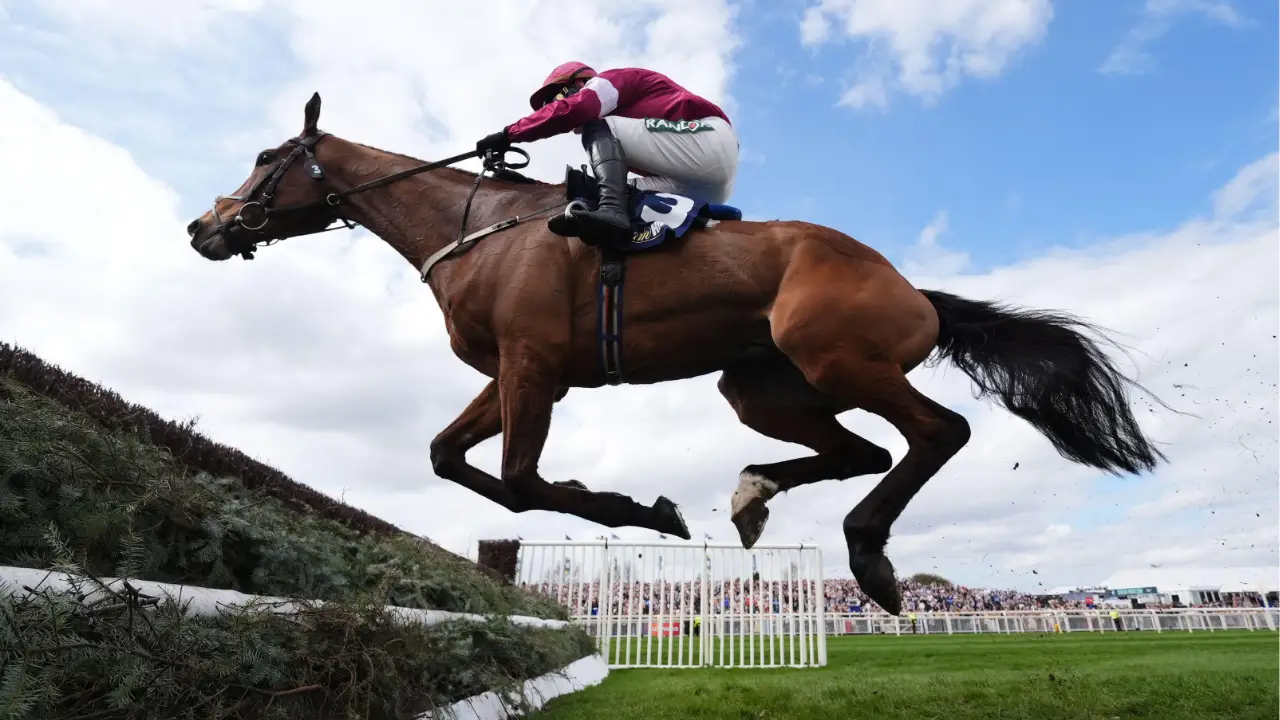
The seven-year-old, trained by the legendary Willie Mullins and owned by Gigginstown House Stud — the operation run by Ryanair boss Michael O’Leary and his brother Eddie — had produced what connections described as an exhibition of jumping, leading the field comfortably and heading for a victory that looked assured long before the final fence.
Then came the mistake. Approaching the last obstacle, Gold Dancer dragged his hind legs through the fence, losing momentum and lurching.
For a fraction of a second it appeared that champion jockey Paul Townend, one of the most decorated and skilled National Hunt riders of his generation, might be thrown.
He wasn’t. He recovered his balance, gathered the horse, and rode him out to the finish line, winning by almost five lengths and claiming the £67,524 first prize.
Fifty yards past the post, Townend glanced back at his mount. Something had changed. He pulled Gold Dancer up immediately and dismounted. Veterinary staff arrived within moments.
Green screens were erected around the horse to shield him from the crowd. And within a short time, the diagnosis was confirmed: Gold Dancer had broken his back at the final fence. He was euthanised on the track.
Why didn’t he stop?
The question that exploded across social media within minutes of the screens going up was the one that Townend and the sport’s authorities had to answer: why didn’t the jockey pull up immediately after the final fence mistake, rather than riding the horse out to the line?
It is a question that contains genuine moral weight. If the horse had broken his back at the fence, he had covered the final furlong to the finish line in agony, the Irish Times reports.
He had been ridden out — and, footage showed, urged on with the whip — while carrying an injury that would prove fatal. The images were deeply uncomfortable to watch.
Townend, who chose not to speak to media after the race, gave his account instead to the stewards’ inquiry that followed as a matter of course, per MailOnline.
His explanation, subsequently supported in full by the British Horseracing Authority’s own director of equine welfare, was precise and consistent.
He told the stewards that after the mistake at the final fence, Gold Dancer had taken a stride or two to gather himself — but had then run on in a straight line to the finish.
The horse felt sound beneath him. It was only after crossing the line, as Gold Dancer rounded the bend toward the pull-up area and his gait changed from a canter to a trot, that Townend noticed something was wrong. At that point, he dismounted immediately.
“It was only until rounding the bend towards the pull up area that the gelding’s action changed,” the stewards’ report stated. “Gold Dancer went from a canter to a trot, after which he immediately dismounted from the gelding.”

The BHA director who backed him
The critical voice in the inquiry was not Townend’s, but that of James Given, the BHA’s Director of Equine Regulation, Safety, and Welfare.
Given watched footage of the incident from multiple angles and gave evidence in the inquiry — and his conclusion was unambiguous.
“The horse felt normal to him,” Given told ITV Racing, per Reuters. “He came up very quickly and took one half-stride to get organised and galloped away. He ran straight as an arrow to the line.
He didn’t show any signs of deviating off a straight line or not being asymmetric. The back legs were following the front legs.”
Given was explicit about the moment the change became visible. “It was only after they had gone past the winning line and turned left that the action changed. That was the only point at which Paul became aware. I don’t believe he was able to notice that injury at all.”
The stewards accepted both accounts and noted Townend’s explanation without imposing any sanction.
Willie Mullins, speaking to Racing TV, offered a characteristically measured defence of his jockey.
“Paul said to me the horse galloped through the line fine, went down to his slow pace at a canter and then just as he turned he went into a trot and that was the first he felt,” the trainer said.
“I would say he didn’t feel that the horse had any damage and he galloped all the way to the line.”
Mullins also pushed back on the broader suggestion that jockeys should simply stop whenever a horse makes a jumping mistake. “It’s like a forward going for goal,” he said.
“He’s going to keep going and if something happens he’s going to keep going and kick the ball into the back of the net if he can. Same with the jockey. Unless they feel that the horse’s action really wrong, he’s not going to stop, because if he stops he’ll lose his licence.”
He added, with evident sadness: “If Paul thought there was something wrong he’d be the first one to pull him up.”
Eddie O’Leary, speaking on behalf of the horse’s owners, was similarly direct. “It’s terribly sad for the horse. What could Paul Townend do? He felt fine, it was just when he pulled up that something was wrong.”
A wider reckoning
The sport’s response to the inquiry may have cleared Townend of wrongdoing, but it has done little to quell the broader controversy.
The incident occurred against a backdrop of already heightened scrutiny of horse racing’s safety record. Just a month earlier, four horses had died at the Cheltenham Festival, including two on the final day.
A total of 68 horses have died at Aintree since 2000. In 2025, the BHA reported a fatal injury rate of 0.22 percent across all UK racing — down from 0.25 percent the previous year, a figure the industry regards as evidence of progress.
Animal welfare organisations took a different view. PETA described the Grand National Festival as ‘The Grand Massacre.’
The League Against Cruel Sports called for a public boycott of the event and government intervention.
“Year after year we see horses dying at Aintree for people’s entertainment and a cheap bet,” said Emma Slawinski, Chief Executive of the League Against Cruel Sports. “The public and businesses should boycott the Aintree Festival, refuse to bet on the racing, and stop watching the ITV coverage which glosses over the animal cruelty.”
The RSPCA noted that Gold Dancer’s death was the 42nd horse fatality linked to competitive racing in the UK in 2026 alone — and it was only April. “Lessons must be learned from any tragedy like this,” the organisation said, adding that it would be speaking with the BHA about prevention measures.
Animal Aid’s Campaign Manager Isobel McNally was blunter still. “This is a horrifying thing to happen to an animal, all in service of an event that, looking at ITV coverage, appears to be more of a social event for attendees. Everyone who has bought a ticket or placed a bet has paid for this horse to die.”
For Willie Mullins, the loss was felt more personally. “It’s a big loss out of the yard because he was improving all the time,” the trainer said. “Today, to give such an exhibition of jumping, to give his owner, give me, give Paul, all the people who backed him such a thrill — and then for that to happen after the line was unbelievable.”