I flew across the country with gifts in my suitcase and my best dress on, thinking I was finally going to have the family visit I’d been waiting on for months. By the end of the first 15 minutes, I was sitting alone on a motel bed wondering whether I had just learned my place in my own son’s life.
My son left me on his porch for 15 minutes, and I almost went home without ever meeting the surprise he planned for me
I thought Nick was joking when he said, “Mom, you can come anytime.”
He had been saying versions of that for years.
“We should get you out here.”
“The kids ask about you.”
“We’ll plan something soon.”
But a month ago, he sounded serious.
“Pick a weekend,” he said. “We’ll make it work.”
So I did.
I booked the flight early. I called twice to confirm the date. I packed carefully. I bought gifts for the kids. A rabbit for Emma. Puzzle books and toy cars for the boys. I even bought a new dress. Blue. Simple. Nice enough to show I had made an effort.
I wanted to look like I belonged in my son’s house.
The Uber driver said, “Big family visit?”
I smiled and said, “I hope so.”
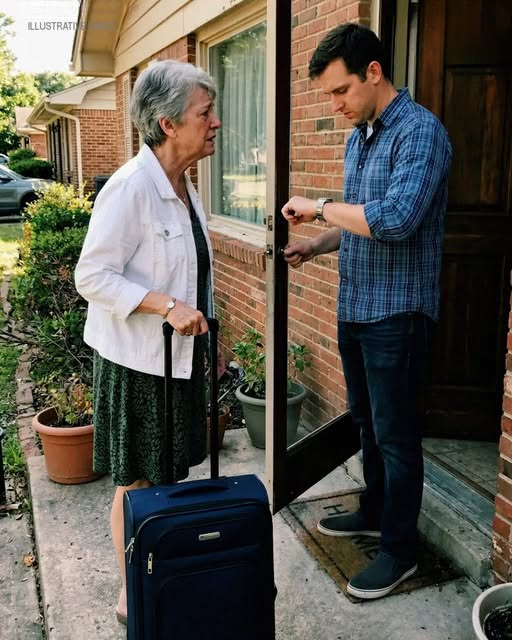
Nick had told me to come at four. I got there at 3:45 because the Uber was fast. I stood on the porch smoothing my dress and checking my lipstick in my phone screen.
Then Nick opened the door.
He did not hug me.
He looked past me toward the street first.
“Mom,” he said. “We said four. It’s only 3:45.”
I laughed because I thought he had to be kidding.
“I know, honey. The Uber was fast. I couldn’t wait to see everybody.”
He did not smile.
“Linda’s still setting up,” he said. “The house isn’t ready. Can you wait outside? Just fifteen minutes.”
I blinked. “Outside?”
“It’s just 15 minutes.”
I could hear music. Kids running. Somebody laughing.
I said, “Nick, I came from the airport.”
“I know. We just want it to be ready.”
Then he gave me that quick look busy people give when they want you to cooperate without making them explain themselves.
“Please, Mom. Fifteen minutes.”
And then he closed the door.
I stood there staring at it.
So I waited.
Five minutes.
Then ten.
Then fifteen.
Nobody came out.
I sat on my suitcase because my legs were aching. I could hear little feet running inside. Laughter. Music louder now.
I looked at the door and realized something awful.
I was not early.
I was not unexpected.
I was simply less important than whatever was happening inside.
I picked up my phone. I pulled up his contact.
Then I locked the screen.
I got up, took my suitcase, and walked down the driveway.
No one stopped me.
At the corner, I called a cab.
The driver asked, “Where to?”
I said, “Anywhere cheap.”
He took me to a motel 10 minutes away.
I sat there in my blue dress with the gift bag on the chair and felt more tired than I had in years.
I didn’t turn my phone on that night.
Not when I washed my face.
Not when I lay down without changing.
Not when I woke up at three in the morning with my heart pounding.
I turned it on the next morning.
Twenty-seven missed calls.
A pile of texts.
Mom where are you?
Please answer.
Mom please.
Then one came through that made my chest tighten.
Mom, please answer. It was for you.
I stared at that for a long time.
Then another.
Linda was hanging the banner. The kids were hiding in the den. Emma saw you leave from the window and now she won’t stop crying. Please, Mom. Please come back.
My throat closed.
I read the texts again.
I wasn’t sending you away. I just wanted everything ready. I wanted it to be perfect.
Perfect.
Then the phone rang.
Nick.
I almost let it ring out.
Almost.
But hope is stubborn, even when it should know better.
I answered and said nothing.
“Mom?”
His voice sounded smaller than I remembered.
I still said nothing.
He let out a shaky breath. “I messed up.”
I looked at the stained curtain and waited.
“I thought 15 minutes wouldn’t matter,” he said. “I thought you’d wait. I didn’t think…”
He stopped.
Then he said, more quietly, “Emma keeps saying, ‘Grandma thought we didn’t want her.'”
I closed my eyes.
“She was right,” I said.
“No.” His voice cracked. “No, that’s the part I got wrong. I acted like you were one more thing to manage. You came all this way, and I left you outside. I am so sorry.”
I pressed my fingers to my mouth.
In the background, I heard a child ask, “Is she coming back?”
Then another voice: “Tell Grandma I made the sign!”
Nick said, “Mom, please let me come get you.”
I sat down on the edge of the bed.
“I don’t know if I can walk back up that driveway,” I said.
There was a pause.
Then he said, softly, “You won’t walk alone.”
I took a breath that shook.
“Do you know what it felt like to sit on that porch in a dress I bought just to visit you? To hear all of you inside laughing while I sat outside with my suitcase like I was too embarrassing to bring in early?”
He did not answer.
“Do you know what it felt like to realize you were certain I would just accept it? That I would smile and excuse it because you meant well?”
Still nothing.
Then: “Yes.”
I laughed once, sharp and bitter. “No, you didn’t know. Because if you knew, you would have opened the door.”
He was quiet so long I thought the call had dropped.
Then he said, “You’re right.”
Instead he said, “The surprise was real. But that’s not all of it.”
I sat up straighter.
“What does that mean?”
He took a shaky breath. “I keep trying to make everything look smooth. Perfect house. Perfect timing. Perfect family. Like if I keep it all organized, nobody notices what I’ve let slide.”
I said nothing.
“And what I’ve let slide,” he said, voice rough now, “is you.”
“Every time I called you, I was driving or working or doing three things at once. Every time I said we’d plan a visit, I pushed it off because I thought you’d understand. You always do. And yesterday I treated you the same way. Like you’d wait. Like you’d make it easy for me.”
Then I said the thing that had been sitting in me for years.
“I didn’t come here to be managed, Nick. I came here to be wanted.”
He made a sound like I had hit him.
“I know,” he whispered. “And I hate that I made you feel otherwise.”
Nick covered the phone for a second, but I still heard him say, “I hope not.”
Then there was rustling, and suddenly a tiny voice came on the line.
“Grandma?”
My eyes filled immediately.
“Hi, sweetheart.”
“Are you the grandma from my picture?”
I swallowed. “I hope so.”
“I made your hair yellow by accident,” she said. “But Mommy said crayons are hard.”
A laugh came out of me before I could stop it.
Then she asked, in a small voice, “Are you still coming?”
I said, “Put your daddy back on.”
“You can come get me,” I said. “But listen carefully. I am not coming back for one nice evening and then another year of rushed calls and vague promises.”
“You’re right.”
“I want real effort. Real visits. Real phone calls. Not when you can squeeze me in.”
“I know.”
“And nobody leaves me outside that door again.”
His voice broke. “Never again.”
An hour later, there was a knock at my motel door.
When I opened it, Nick was standing there with rain in his hair and a piece of paper in his hand. Emma peeked out from behind his leg.
Nick held up the paper.
It was a crayon drawing. A house. A huge sun. Three children. Two grown-ups. And one woman in a blue dress in the middle.
At the top, in crooked letters, it said WELCOME GRANDMA.
“I should have opened the door the first time,” he said.
I looked at him.
Then Emma stepped around him and said, “I was hiding very quietly and then I saw you leave and I cried a lot.”
I knelt down carefully.
“I’m sorry, sweetheart.”
She threw her arms around my neck.
“You came back,” she said into my shoulder.
“I did.”
She pulled back and frowned. “Are you staying for cake?”
I laughed through tears. “Yes. I think I am.”
On the drive back, Nick didn’t crowd the silence.
At one red light, he said, “I don’t expect this to be fixed today.”
“Good,” I said. “Because it isn’t.”
“I know.”
That was the first honest conversation we’d had in a long time.
When we pulled into the driveway, the front door opened before I reached the steps.
Linda came out first, eyes red, holding one side of a handmade banner. The boys crowded behind her, bouncing and waving.
“I’m sorry,” Linda said immediately. “I should have opened the door myself.”
I nodded. I wasn’t ready to rescue anyone from discomfort.
The banner said HOME IS FULL NOW.
I stood there looking at it, and my chest ached in a different way.
Then one of the boys blurted, “Grandma, I helped tape the flowers but Dad made one fall down and said a bad word.”
The other boy hissed, “You weren’t supposed to tell that part.”
And just like that, the room felt human instead of polished.
I stepped inside.
This time no one asked me to wait.
There were streamers in the living room, paper flowers on the mantel, family photos on every table. My old pictures with Nick as a boy were mixed in with school photos and vacation shots. I saw myself in that house more in five seconds than I had in years.
And that undid me.
I started crying right there in the living room.
Real crying.
I said, “I am here now. But you almost taught me not to come back.”
Nobody spoke.
Nick cried too. Linda covered her mouth. The kids looked confused, then Emma took my hand like she thought maybe that would keep me from disappearing again.
That little hand steadied me.
Later, after cake and presents and too many pictures, after the children were asleep, Nick and I sat at the kitchen table.
He made me tea.
“How much sugar?” he asked.
I looked at him and almost smiled. “Two.”
He winced. “I should have known that.”
“Yes,” I said. “You should have.”
He nodded and handed me the cup, anyway.
Then he said, “I can’t undo yesterday. But I want to do better in ordinary ways. Weekly dinners when you visit. Sunday calls. Actual plans. Not just ‘sometime soon.'”
“Trust is built by repetition,” I said.
“I know.”
The next morning, Emma climbed into my lap before breakfast and asked, “You stayed. Does that mean pancakes?”
“That is exactly what it means,” I told her.
On my way to the kitchen, I passed the front door and glanced at the porch.
Nick saw me pause.
Without saying a word, he crossed the room, opened the door wide, and stood there holding it.
“Come in, Mom,” he said.
I looked at him for a second.
Then I walked through.
This time, I believed him.
This work is inspired by real events and people, but it has been fictionalized for creative purposes. Names, characters, and details have been changed to protect privacy and enhance the narrative. Any resemblance to actual persons, living or dead, or actual events is purely coincidental and not intended by the author.
The author and publisher make no claims to the accuracy of events or the portrayal of characters and are not liable for any misinterpretation. This story is provided “as is,” and any opinions expressed are those of the characters and do not reflect the views of the author or publisher.