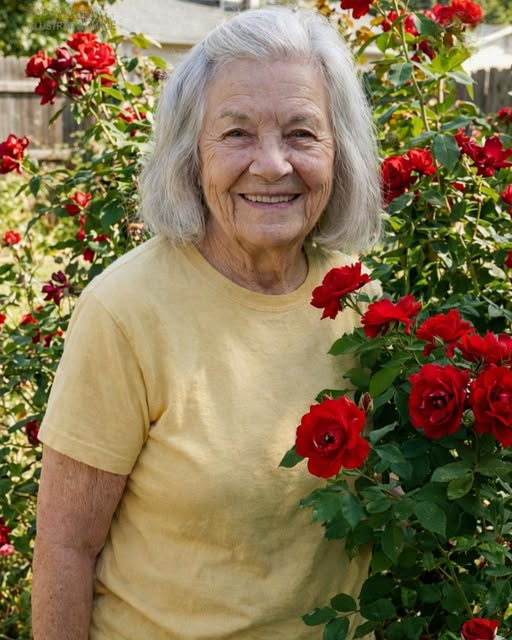
My 78-year-old neighbor was the kind of woman everyone on the street adored. She was sweet, gentle, and felt like family to me. So when she passed away and left me a note and a key to the shed she never let anyone near, I didn’t expect what was waiting inside.
I moved into a quiet little suburb three years ago, and within 48 hours, Mrs. Whitmore was on my porch with a blueberry pie still warm from the oven and a smile that made you feel like you’d known her your whole life.
She was 75 then, a widow, and she lived two houses down in the neatest little white house on the street, with flower beds that changed perfectly with every season.
Mrs.Whitmore became a fixture in my life the way the best neighbors do. We’d talk over the fence, share meals occasionally, and she’d sometimes sit on her porch in the evenings and wave when I drove home from work.
There was one thing that always snagged my attention, though. In Mrs. Whitmore’s backyard, half-hidden behind the fence line, sat an old shed with a rusty padlock on the door. It looked out of place beside her otherwise immaculate property.
Mrs. Whitmore passed away four days ago, quietly in her sleep. She was 78.
The church service was small, mostly neighbors and a few people I didn’t recognize. I was standing outside afterward when a girl of about 11 walked right up to me.
“Are you Amber?” she asked.
“I am.”
She held out a small envelope. “Mrs. Whitmore asked me to give you this today. On the day of her funeral. She said it had to be today.”
I took it, thanked her, and she disappeared into the small crowd before I could ask anything else.
The envelope had my name on it in Mrs. Whitmore’s careful, old-fashioned script. I opened it right there.
A key slid out into my palm, and a folded note with it:
“Amber dear, I should’ve kept this a secret even after my passing. But I can’t. You must know the truth I’ve kept from you all these years. You will understand everything when you open my shed.”
I stood on those church steps with a key in one hand and several questions. And I knew I wasn’t going home without opening that shed.
That evening, I walked around to Mrs. Whitmore’s backyard through the side gate. The yard was still and quiet, her flower beds holding on.
Up close, the shed’s padlock was heavy and brown with rust.
Not thinking twice, I fitted the key into it. It turned on the second try, and the door swung inward with the low groan.
The smell hit me first: cool air, dust, something faintly like clay.
It was dark inside except for the light coming through the open door, and in that light I could see that everything was covered in white sheets. In the center of the shed, larger than anything else, something stood beneath a sheet of its own.
It was human-shaped. Roughly my height. Completely still, like someone was lying there.
I don’t know how long I stood in that doorway. Then I walked forward, grabbed the edge of the sheet with both hands, and pulled.
I screamed, stumbled backward, and my phone was in my hand before I’d made any conscious decision to reach for it.
“911? There’s something here. I need help.”
***
The officers arrived within 10 minutes. One of them pulled the sheet back fully with a flashlight, then turned to look at me.
“Ma’am,” he said, “it’s a sculpture.”
I stepped forward slowly.
He was right. It was a life-sized figure lying on a long worktable, made from sculpted wax and plaster, with details that seemingly took a lot of time to develop. And the face, when I leaned in closer, looked like mine.
I stood there staring at the figure and felt something cold move through me that had nothing to do with the temperature in the shed.
“Is everything alright, ma’am?” the officer asked from behind me, and I honestly wasn’t sure how to answer that.
I apologized to the officers, thanked them for coming, and waited until they’d gone. Then I turned back and looked further.
On the workbench beside the sculpture, partially tucked under a cloth, were sketches. Dozens of them, loose and stacked, some rolled and tied with string.
I picked up the first one. It was a pencil drawing of a young woman’s face, precise and careful, the kind of work that comes from someone who has drawn the same subject for a very long time.
It was the face in the sculpture. It was my face.
But something didn’t add up when I looked at the date in the corner.
“March 12th, 1995? That’s 31 years ago.”
I picked up another one. Same face, slightly different angle. And there was something about it now, something I couldn’t ignore anymore. The woman looked a lot like my mother.
One after another, the same face appeared across decades, aging slightly in some, younger in others, as though someone had been imagining a whole life in pencil and paper over 30 years.
Then I found an envelope tucked beneath the sculpture’s head, pressed flat against the table. My name was on it in Mrs. Whitmore’s handwriting. Beneath it was a bundle of old photographs, the kind with the slightly washed-out color of pictures taken in the early 90s.
I held the first one up to the light. Two women, arms around each other, smiling at the camera. The older one was a younger Mrs. Whitmore, her hair still mostly dark. The younger woman beside her was maybe 20, laughing at something just off-frame.
She looked exactly like a photograph of my mother at 20 years old.
A memory surfaced without warning. About a few weeks after I’d moved in, I’d been showing Mrs. Whitmore something on my phone and accidentally swiped to a photo of my mom.
“That’s my mother, Jeanne,” I’d said without thinking.
Mrs. Whitmore had gone very quiet. She’d looked at the screen a beat longer than the moment called for.
I’d thought nothing of it at the time.
I opened the letter.
Mrs. Whitmore wrote that she had known her health was failing and had arranged, through a young girl she’d befriended at the hospital during her treatment, for the envelope to reach me on the day of her funeral. She wrote that she had carried this truth for too long and that I deserved to know it, even if she wasn’t there to give it to me in person.
Then came the sentence that made my knees go out completely.
“Amber, you are my granddaughter. I knew it the day you showed me your mother’s photo on your phone. You have her face, and your mother is my daughter.”
I sat down on the floor of that shed, utterly numb.
Mrs. Whitmore was my grandmother. She had known, and she had said nothing.
She had spent three years being my neighbor when she could have just told me she was my grandmother, and I needed to understand why.
***
I drove to my mother’s house in the city with the photographs on the passenger seat and the letter in my coat pocket.
My mother, Jeanne, was in her kitchen when I arrived. She took one look at my face and set down what she was holding. I put the photographs on the kitchen table without a word and watched her face.
She went very still. Then she sat down slowly, picked up the top photograph with both hands, and looked at it for a long time.
“Where did you get this?”
“From Mrs. Whitmore’s shed. My neighbor. She left me a letter, Mom. She said she was your mother. And I’m her granddaughter.”
My mother pressed one hand over her mouth.
“Mom? What’s wrong?”
I sat down across from her and waited, because whatever she was carrying, she’d been carrying it alone for a very long time.
It came out slowly and in pieces, the way things do when someone has kept them locked away for years.
Mrs. Whitmore and her husband had adopted my mother as an infant and raised her with everything they had. When my mother graduated, her father had just been diagnosed with cancer, and his one wish was to see his daughter married before he lost the ability to be present for anything.
But my mother was in love with someone her parents didn’t know, and when the pressure became too much, she did what frightened people sometimes do.
She left a note, took the man she loved, my father, and ran.
“I told myself I’d explain later,” Mom said, pressing her lips together as if she were trying to hold something back. “That I’d go back and make them understand. But later kept moving further away.”
My father passed away less than two years after they eloped and married, and my mother was left alone with a baby and a guilt she didn’t know how to put down. When she eventually went back to make things right, Mrs. Whitmore had sold the house and moved with no forwarding address.
“I thought my mother cut me off completely,” Mom explained. “I thought I’d lost her for good.”
She had no idea that her mother had spent the next 30 years sculpting her face from memory so that she wouldn’t forget it.
I told Mom about the shed then. The sculpture, the sketches dated across three decades, and the letters.
Her face crumpled completely.
“My mother sculpted,” she said, half to herself. “She used to say she could remember a face forever once she’d drawn it. She never forgot me.”
***
We drove back to Mrs. Whitmore’s place together that evening.
I unlocked the shed and stood back while my mother walked in slowly. She stood in front of the sculpture for a long time without speaking, then crouched beside the workbench and went through the sketches one by one.
I silently watched 30 years of guilt and grief move across Mom’s face in real time.
“She kept drawing the same face,” she said finally, turning another page slowly. “Over and over… as though she was trying not to forget.”
The following morning, we visited the cemetery together. Mrs. Whitmore had been laid to rest beside her husband, my grandfather. My mother stood at the grave for a long time, then crouched and pressed her hand flat against the headstone.
“I’m so sorry, Mom… Dad,” she cried. “I’m sorry I left. I’m sorry I didn’t come back. I’m sorry you never got to know your granddaughter.”
I put my hand on her shoulder. “They’re together now. And she made sure I knew the truth.”
My mother reached up and covered my hand with hers, and we stayed like that for a while, the cool March wind brushing past us.
***
Three days later, a lawyer called.
His name was Mr. Calloway, and he asked if I could come in and whether I’d like to bring my mother. I said yes to both.
We sat across from his desk on a pleasant morning, and he handed us each an envelope before saying anything about the will. One was addressed to me, and the other to my mother.
I opened mine first.
“Amber,
I knew the moment I saw you, and I knew for certain the day you showed me your mother’s photo. I was afraid to say it out loud. Afraid of losing you before I even had you. So I stayed close in the only way I could. Every pie, every wave, every small moment… that was my way of loving you, sweetheart.
It may not have been enough. But it was everything I had.
You were the sweetest part of my life…”
My voice caught before I could finish.
My mother was already reading hers. Her hands trembled as she pressed the paper closer.
“She forgave me,” she whispered. “After everything… my mother forgave me.”
I set the letter down and looked at my mother; something quiet and unspoken passed between us.
Mr. Calloway opened the will. Mrs. Whitmore, my grandmother, had left everything to me.
The house, its contents, and the savings she’d quietly accumulated over a careful and modest life. All of it, to a granddaughter she had loved from a distance and never once stopped believing in.
Mrs. Whitmore never got to say the word grandmother out loud. But she made sure I’d know, when the time came, that she’d always have known exactly who I was.
This work is inspired by real events and people, but it has been fictionalized for creative purposes. Names, characters, and details have been changed to protect privacy and enhance the narrative. Any resemblance to actual persons, living or dead, or actual events is purely coincidental and not intended by the author.
The author and publisher make no claims to the accuracy of events or the portrayal of characters and are not liable for any misinterpretation. This story is provided “as is,” and any opinions expressed are those of the characters and do not reflect the views of the author or publisher.