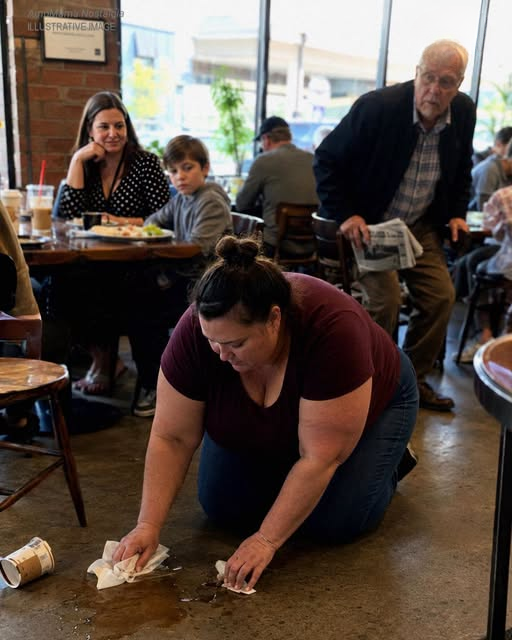
I stopped at a neighborhood bistro for a quiet cup of coffee, but one cruel joke from a child turned the entire restaurant silent. Then the owner stood up, looked at the boy’s mother, and revealed he knew far more about her than anyone expected.
Last Tuesday, I stopped at a small neighborhood bistro after a stressful morning.
I ordered coffee and took a table near the wall.
Near the back, a plus-size woman sat alone, reading a paperback beside her lunch. A faded photograph marked her place between the pages.
The boy kept glancing at her before he spoke or moved.
A few minutes later, a stylish woman entered with a boy who looked about seven.
They sat beside me.
The woman wore a cream coat, gold earrings, and the kind of expression that suggested every room should adjust itself around her.
The boy kept glancing at her before he spoke or moved.
How could I not notice that?
As she approached our tables, the boy looked at his mother.
The woman near the back turned another page.
A few minutes later, she stood and headed toward the restroom.
She moved carefully through the narrow aisle.
As she approached our tables, the boy looked at his mother.
She gave him the slightest smirk.
Then he stuck out his foot.
The boy grinned.
Then he stuck out his foot.
The woman caught her shoe against it and stumbled.
Her coffee hit the floor, and the cup shattered.
Nobody else was laughing.
Luckily, she’d grabbed the back of an empty chair before she fell, and she just ended up with coffee over her shoes.
After she regained her composure, she looked up to a deathly quiet restaurant.
The boy gave a nervous laugh.
He kept smirking until he looked around.
Nobody else was laughing.
Her face had gone red, but she looked at the boy and gave him a gentle smile.
His smile disappeared as the woman straightened her clothes out.
Her face had gone red, but she looked at the boy and gave him a gentle smile.
“It’s all right,” she said. “Are you okay?”
The boy blinked, presumably in surprise.
Upon realizing she’d have to back her kid up in this, she changed tactics.
Before he could answer, his mother pushed back her chair.
“Oh, please,” she scoffed. “He’s fine. It was obviously a joke or something.”
The woman looked at her, scowling at that point.
The mother slowly looked her up and down. Upon realizing she’d have to back her kid up in this, she changed tactics.
“Honestly, if you were not taking up half the aisle, people wouldn’t be tripping over you.”
Someone gasped.
The woman said nothing as she crouched to pick up a napkin.
There wasn’t much the disgraced woman could do. She just lowered her eyes.
The mother folded her arms.
“It’s a simple bit of health advice, sweetheart.”
The woman said nothing as she crouched to pick up a napkin.
An older man near the window folded his newspaper.
Finally, a server rushed over.
“Please don’t clean that. I’ll handle it. What’s your name, ma’am?”
“Oh, I’m Grace,” the woman stuttered. “And it’s fine, really.”
“No,” the server replied. “It’s not.”
An older man near the window folded his newspaper.
“Children make mistakes, but they also learn whom they’re allowed to treat as less.”
He stood and walked toward them.
He looked at the boy first.
“Children make mistakes,” he said calmly. “But they also learn whom they’re allowed to treat as less.”
The mother gave him a cold look.
“This is none of your business.”
“It became my business when it happened in my restaurant.”
“I come here every day, you can’t do this to me.”
Her expression changed.
The older man nodded toward the woman beside the broken cup.
“Apologize to Grace. Have your son do the same. Then leave.”
The mother crossed her arms.
“For what, Arthur? Telling the truth? I come here every day, you can’t do this to me.”
He leaned closer and lowered his voice.
The older man’s face hardened.
He leaned closer and lowered his voice.
“Before you learned to speak to people like this, Vanessa, your mother used to clean this restaurant.”
Every bit of color left her face.
She stared at him.
Grace returned to her table, picked up the faded photograph from her book, and carried it back.
“My mother never worked here.”
Grace stopped reaching for the broken cup.
The older man looked at her.
Grace returned to her table, picked up the faded photograph from her book, and carried it back.
She placed it in front of the boy.
The older man was there too, much younger, with darker hair and a towel over one shoulder.
The picture showed two women in restaurant aprons standing behind a counter.
The older man was there too, much younger, with darker hair and a towel over one shoulder.
Grace stood to one side, perhaps fifteen years old.
A small girl sat on a flour sack near the kitchen door.
The boy leaned closer.
The older man tapped the photograph.
“That’s you,” he said to his mother.
She looked away.
The older man tapped the photograph.
“Your grandmother worked here, Vince.”
The woman tightened her grip on her bag.
“I’m telling him only what matters.”
“You do not need to tell him anything.”
“I’m telling him only what matters.”
He looked at the boy.
“Your grandmother worked long hours after your grandfather left. She brought your mother here after school because she could not afford child care.”
The boy stared at the small girl in the photograph.
Grace added, “I watched your mother while our mothers finished closing. My mother shared food and clothing with them when money was tight.”
The boy stared at the small girl in the photograph.
“You told me Grandma grew up rich.”
His mother said nothing.
Grace covered it with her hand.
“You said your family had a big house.”
She reached for the picture.
Grace covered it with her hand.
“No.”
Vanessa’s eyes flashed.
“Did my grandma really clean here?”
“That belongs to me.”
“It belonged to my mother,” Grace said. “She gave it to me before she died.”
Vince looked at Grace.
“Did my grandma really clean here?”
“Yes.”
“She never treated anyone as though they mattered less.”
“Was she good at it?”
Grace’s face softened.
“She was one of the hardest-working women I ever knew.”
Vince glanced at his mother.
Grace continued.
Two women at a nearby table were staring at her.
“She never treated anyone as though they mattered less.”
Arthur stepped back.
“You and your son need to leave.”
Vanessa looked around.
Two women at a nearby table were staring at her.
She suddenly seemed much smaller.
One of them clearly recognized her, and Vanessa noticed.
Her posture changed.
She suddenly seemed much smaller.
With a last glance around her, Vanessa grabbed her bag.
“Come on,” she told her son.
He did not move.
“You always say people who clean houses didn’t work hard enough in school.”
“Mom, why did you lie?”
“We will talk at home.”
“You always say people who clean houses didn’t work hard enough in school.”
Her face tightened.
“I said we are leaving.”
His mother pulled his arm.
The boy looked at Grace.
“I am sorry.”
Grace nodded.
“Thank you.”
His mother pulled his arm.
“Are you mad at me?”
The boy resisted for one more second.
“Are you mad at me?”
Grace looked at him carefully.
“What you did was cruel.”
His eyes dropped.
“Remember how this felt before you laugh at someone else.”
“But you can decide not to do it again.”
He nodded.
Grace said, “Remember how this felt before you laugh at someone else.”
The mother led him out.
The door closed behind them.
Arthur bent to pick up the broken cup.
For several seconds, nobody spoke.
Arthur bent to pick up the broken cup.
Grace moved to help.
He shook his head.
“Sit down. Your lunch is getting cold.”
Apparently, the two diners nearby knew her from a charity committee.
She gave him a tired smile.
“So is everyone else’s.”
A few people laughed, but gently.
***
After the entire ordeal, I went to speak to Arthur.
Three days later, I returned to the bistro.
Apparently, the two diners nearby knew her from a charity committee. Vanessa had spent months presenting herself as someone raised around wealth and family connections.
They had heard enough to question the story.
Three days later, I returned to the bistro.
Grace sat near the back with another book.
Before I could ask about Vanessa, the door opened.
Arthur was behind the counter.
Before I could ask about Vanessa again, the door opened.
A woman in her sixties walked in carrying an old canvas handbag.
She had silver hair and work-worn hands.
Arthur went mute.
“I heard what happened.”
“Linda.”
She crossed the room and hugged him.
He held her tightly.
“I heard what happened,” she said.
Grace stood.
“I raised the person who did.”
Linda turned toward her.
“I am sorry.”
“You didn’t say those things,” Grace replied.
“I raised the person who did.”
“Vanessa is responsible for Vanessa.”
She had clearly followed her mother.
Linda looked relieved and wounded at the same time.
Then the door opened again.
Vanessa walked in.
She had clearly followed her mother.
“Mom, please,” she said. “Do not do this here.”
Vanessa glanced around the restaurant.
Linda turned.
“Where should I do it?”
Vanessa glanced around the restaurant.
The same fear returned to her face.
“Somewhere private.”
“I was embarrassed.”
“You weren’t worried about privacy when you humiliated Grace.”
Vanessa lowered her voice.
“I came to explain.”
Linda waited.
Vanessa looked at Arthur, then Grace.
“People treated me differently when they learned how I grew up.”
“I was embarrassed.”
Grace said nothing.
Vanessa continued.
“People treated me differently when they learned how I grew up.”
Linda’s expression didn’t change.
“You taught him confidence meant standing above someone else.”
“I wanted my son to have confidence,” Vanessa said.
“Confidence in what?”
“In himself.”
“You taught him confidence meant standing above someone else.”
“That is not what I taught him.”
“He looked at you before he tripped her.”
Linda looked toward the spot where the coffee cup had shattered.
“He looked at you before he tripped her.”
Vanessa’s face tightened.
“I didn’t tell him to do it.”
“You smiled.”
“You encouraged him.”
“It happened quickly.”
“You encouraged him.”
Vanessa looked at Grace.
“What do you want me to say?”
Grace closed her book.
“My deepest disappointment is not that you hid from those years.”
“The truth would be a start.”
Vanessa swallowed.
“My deepest disappointment,” Linda said, “is not that you hid from those years.”
Vanessa’s eyes filled.
Linda looked down at her own hands.
“I worked hard to give him things I never had.”
The hands that had scrubbed these tables and packed her daughter’s school lunches afterward.
“It is that you turned those years into a reason to look down on people who live the way we did.”
“I wanted better for him.”
“Better is not the same as cruel.”
“I worked hard to give him things I never had.”
“So did I.”
“I was never ashamed of working here.”
Vanessa began crying.
Linda’s voice remained steady.
“I was never ashamed of working here.”
“I was.”
“I know.”
Vanessa covered her mouth.
“You do not understand what it was like at school.”
“I know exactly what it was like to be poor.”
“That is not the same.”
“No,” Linda said. “I also knew what it was like to go home exhausted and still make sure you had dinner.”
Vanessa covered her mouth.
“You taught your son that people who do it deserve contempt.”
Linda continued.
“You did not only hide my work. You taught your son that people who do it deserve contempt.”
“I never said that.”
“You said enough for him to understand.”
Vanessa looked at Grace.
Vanessa took a shaky breath.
“What he did was wrong.”
Grace waited.
“What I said was wrong,” Vanessa added.
“Go on.”
Vanessa took a shaky breath.
Nobody rescued her from the silence that followed.
“He learned it from me.”
Nobody rescued her from the silence that followed.
Finally, Grace said, “So you made sure somebody else felt less before anyone could make you feel that way.”
Vanessa lowered her eyes.
“Yes.”
Arthur folded his arms.
“Your son deserves the truth.”
Vanessa nodded.
“I know.”
Linda stepped closer.
“Tell him who his grandmother is.”
“Do you?”
“Yes.”
“Then tell him who his grandmother is.”
Vanessa looked at her mother’s hands again.
For the first time, she reached out and held one.
Grace did not offer forgiveness.
Linda did not pull away.
Grace did not offer forgiveness.
Vanessa looked toward her.
“I am sorry.”
Grace kept one finger between the pages of her book.
“An apology does not change that in one afternoon.”
“I believe you are sorry.”
Vanessa waited.
Grace continued.
“But I do not know you anymore. An apology does not change that in one afternoon.”
“I understand.”
A month later, Arthur organized a neighborhood luncheon honoring former staff members.
“Do not say you understand. Show your son something different.”
Vanessa nodded.
Then she left with Linda.
A month later, Arthur organized a neighborhood luncheon honoring former staff members.
I arrived before opening time to help set out plates.
Linda came through the kitchen carrying a tray of rolls.
Vanessa was already there with her son.
They were wiping tables.
Linda came through the kitchen carrying a tray of rolls.
The boy ran to her.
“Grandma, Mom told me you used to work here.”
Linda looked at Vanessa.
“Mom said you worked here when you had nowhere else to go.”
Vanessa nodded.
“I told him the truth.”
The boy held his grandmother’s hand.
“Mom said you worked here when you had nowhere else to go.”
Linda smiled.
“Were you embarrassed?”
“A lot of people helped us.”
“Were you embarrassed?”
“No.”
He looked at Vanessa.
She stopped wiping the table.
Near the entrance, Arthur had framed the old photograph.
“I was,” she said. “But I should not have been.”
Near the entrance, Arthur had framed the old photograph.
The boy walked over to it.
He pointed to the small girl on the flour sack.
“Is that really you?”
Vanessa glanced toward the back of the restaurant.
Vanessa joined him.
“Yes.”
“And that is Grandma?”
“Yes.”
“And Grace watched you?”
“Why is it up here where everyone can see it?”
Vanessa glanced toward the back of the restaurant.
Grace was arranging books for a small donation table.
“Yes.”
Vince studied the photograph.
“Why is it up here where everyone can see it?”
“I should have taught you to be proud of that.”
Vanessa looked at her mother in the apron, Grace beside her, and Arthur behind the counter.
Then she looked at her son.
“Because this is where our family was helped back onto its feet.”
She took a breath.
“I should have taught you to be proud of that.”
Vanessa reached toward the frame as though she might straighten it.
The boy nodded and ran back to Linda.
Vanessa reached toward the frame as though she might straighten it.
Then she stopped.
For the first time, she left the photograph where everyone could see it.