I thought the hardest part of this year was watching my teenage daughter try to be brave while I went through chemo. Then one phone call from her school turned our whole life inside out.
My daughter Ava is 15, and for most of her life it has been just the two of us.
Her father, Daniel, was declared dead when she was four.
Car accident on a rain-slick road outside town. Fire. Closed casket. A police officer at my kitchen table saying, “I’m so sorry.” A funeral I barely remember. A death certificate I signed through a fog so thick I could hardly read my own name.
A few weeks ago, my hair started coming out in clumps.
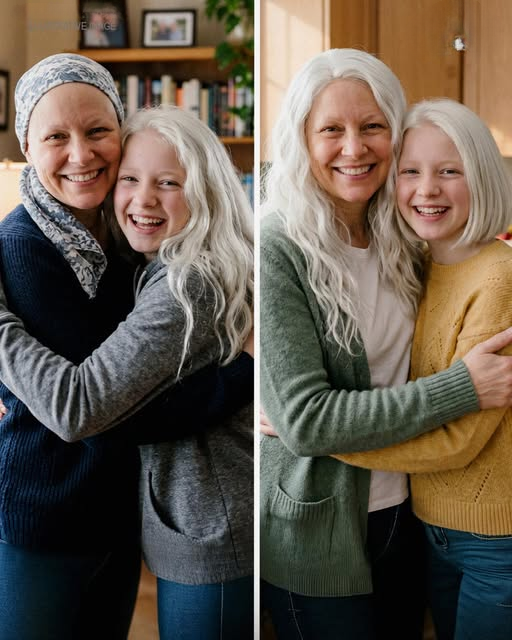
So I cut my hair short, wrapped scarves around my head, and tried to act like it did not matter.
Then one afternoon she came home from school, dropped her backpack by the door, and held out a box.
“I got you something,” she said.
I was at the kitchen table pretending to drink soup. “From where?”
“Open it.”
I looked up at her. “Ava… how?”
She didn’t answer right away. She just reached up and pushed back the hood of her sweatshirt.
Her hair was gone.
I stood up so fast my chair scraped hard across the floor.
“What did you do?”
She said quickly, “I sold some of it, and the rest I gave to Ms. Carla at the salon. She made the wig for you.”
She swallowed and looked down. “I knew we couldn’t afford one. And I know you say it’s just hair, but I also know you miss feeling like yourself.”
I crossed the kitchen in two steps and pulled her into me so hard she let out a little sound.
She pulled back just enough to look at me. “You’re my mom.”
That was it. I cried. Full-on, ugly, helpless crying.
She hugged me again and muttered, “Okay, wow. I was trying to do a nice thing. I did not expect this much sobbing.”
I laughed through tears. “You are unbelievable.”
“You raised me.”
She shrugged. “You gave up way more.”
I turned around and cupped her face. “I don’t ever want you thinking you have to fix this for me.”
“I know,” she said.
But she said it in a way that meant: I was still going to try.
The next morning, she went to school and I went to chemo.
It was a bad session. One of the bad ones where even the ride home feels impossible. By the time I got inside the house, I was so weak I had to sit on the edge of my bed just to take my shoes off.
That was when my phone rang.
It was the school.
I answered right away.
“Hello?”
“Ms. Elena?” It was Ava’s history teacher. “I need you to come to school immediately.”
I sat up straighter. “Why? Is Ava okay?”
There was a pause. “She is safe. But there are police officers here, and they need to speak with you both.”
Every part of me went cold.
“Police? Why would the police be with my daughter?”
“I think you need to hear it in person.”
“Put Ava on.”
A few seconds later, Ava came on. Her voice was shaky.
“Mom?”
“What happened?”
“I found something.”
“What does that mean?”
“I didn’t do anything wrong, I swear.”
“What did you find?”
“Please just come.”
The principal’s office door was open.
I don’t remember the drive clearly. I remember red lights. I remember gripping the wheel so hard my hands hurt. I remember thinking of every terrible possibility in under 10 minutes.
By the time I reached the school, my legs felt hollow.
The principal’s office door was open. Three officers were inside. So was the principal. Ava was sitting in a chair by the wall with red eyes and both hands clenched in her lap.
I went straight to her.
That should have helped. It did not.
“Are you hurt?”
She stood up fast and grabbed me. “No.”
“Then what is this?”
One of the officers spoke in a careful voice. “Ma’am, please sit down.”
I looked at him. “Tell me what happened first.”
He nodded once. “Your daughter is not in trouble.”
That should have helped. It did not.
I sat because my body was starting to give out on me.
The officer placed a folder on the desk and opened it.
“We’ve been investigating financial irregularities connected to the old children’s home that used to stand on part of this property,” he said. “This morning, your daughter found something hidden in the theater storage loft. It may be connected.”
I looked at Ava. “What did you find?”
Her voice shook. “I stayed after class to help move costume racks. One of the boards under the back shelf was loose. There was a tin box under it. I saw Dad’s name on an envelope, so I took it straight to the office.”
My whole body went still.
The officer reached into the folder and slid a photo toward me.
I forgot how to breathe.
It was Daniel.
Not someone who looked like him. Not maybe him. Him.
Older than in the last picture I had, but unmistakably him.
Standing outside a small blue house.
I heard myself say, “No.”
Ava grabbed my hand. “Mom?”
I looked at the officer. “Where did you get this?”
“It was inside the box.”
He slid over more papers. Bank records. Notes. Copies of letters. A photocopy of a report from the year Daniel was declared dead.
My head started pounding.
The officer said, “We now believe your husband did not die in that crash.”
I stared at him.
“No. I had a funeral.”
“Yes,” he said quietly. “And we believe you were deliberately misled.”
My mouth went dry. “By who?”
“A former county official, now deceased, who had ties to the children’s home board. We believe he identified the body for the record before you ever saw anything. The remains were badly burned. You were told not to view them. The paperwork was rushed through. At the time, it looked legitimate.”
It came back to me all at once. The officer in my kitchen. The closed casket. Me asking, “Can I see him?” and being told, “I wouldn’t advise it.”
I had been so broken I had accepted every word.
I whispered, “Why would anyone do that?”
The officer glanced at the other two before answering.
“Because your husband had started collecting evidence that donor money meant for children at that home was being diverted into private accounts. He believed some birth records and guardianship papers had also been altered to hide the theft. We think he got too close.”
Ava made this awful little sound next to me.
I looked at her and grabbed her hand harder.
The officer slid one final page toward me.
It was not a birth certificate with another woman’s name. Thank God. I do not think I could have survived that on top of everything else.
It was a trust record.
Ava’s name was on it.
So was Daniel’s.
A large amount of money had been placed into an account for her the week she was born. Then, over the years, most of it had been quietly moved, renamed, hidden, and split through shell charities linked to the old home.
I looked up. “What is this?”
“Your daughter was the legal beneficiary of a family trust tied to land donated to the home years ago. Your husband found out the trust was being drained. That appears to be what he was trying to stop.”
Ava blinked hard. “So… this is about money?”
The officer shook his head. “About money, fraud, and whoever helped cover it up. The point is, your father knew you were at the center of it.”
Then he handed me an envelope.
My hands started trembling before I even opened it.
Because I knew the handwriting, which read:
For Elena and Ava, if this is ever found.
I opened it.
Elena,
If you are reading this, then I could not come back safely.
Believe me on one thing first: I never left you by choice.
I found proof that money set aside in Ava’s name was being stolen through the home and protected by people with influence here. I tried to go through the right channels. That was a mistake.
If they decide I am dead, let them. Keep Ava away from anyone asking about old records or donations.
If it becomes impossible to stay hidden from this, go to Marina Vale. Blue house near the church. Ask for Rosa. She knows what I could not put in writing.
Tell Ava I loved her every day I was gone.
-Daniel
I had to stop reading because I couldn’t see.
Ava was crying openly now. “He was alive?”
I looked at her, then at the letter. “I don’t know what he is now.”
The principal spoke for the first time.
“I know Rosa.”
We all turned.
She looked pale. “Not personally. But my predecessor used to mention her. She volunteered at the home years ago. When the investigations started, her name kept coming up in old archived files. She was one of the few people who tried to report concerns.”
One of the officers nodded. “We already checked. Rosa is real. Still alive. Still in Marina Vale.”
Ava’s voice came out small. “Why didn’t Dad just come back?”
The room went quiet.
Then the officer answered gently. “We don’t know yet. But if he believed people around him were corrupt, he may have thought staying away was the only way to protect you both until he had proof.”
I hated that answer because it made too much sense.
Ava looked at me then, really looked at me, like she was scared I might break apart in front of her.
Instead, I reached over and held her face in both hands.
“Listen to me,” I said. “Whatever we find out next, you are still my daughter. Nothing touches that. Nothing.”
She nodded once and covered my hands with hers.
Then she asked, “What do we do?”
For the first time in months, I knew.
I looked at the letter. Then at the officers.
“We go to Marina Vale.”
One of them said, “We can arrange an escort in the morning.”
That night, Ava and I packed one bag.
I was so tired I had to sit down twice just folding clothes, but adrenaline will do strange things to a sick body.
At one point I looked over and saw Ava carefully placing the wig she made me on top of my things so it would not get crushed.
I said, “After today, you’re still worried about my wig?”
She gave me a weak smile. “Obviously.”
I sat beside her on the bed.
“We may not like what we find tomorrow.”
“I know.”
“We may find out your father made choices I don’t understand.”
“I know.”
“But we go together.”
That got the first real expression out of her since the office. She leaned into my shoulder and whispered, “Always.”
I barely slept.
Somewhere close to dawn, I realized that for the first time in a year, the thing beating hardest in me was not fear.
It was hope.
By morning, we would be driving to a blue house near a church. To a woman who might know why Daniel vanished. To answers tied to Ava, to me, and to the life I thought had been buried fifteen years ago.
And what I did not know yet was this:
Someone had already knocked on Rosa’s door before sunrise.
And she had let him in.
This work is inspired by real events and people, but it has been fictionalized for creative purposes. Names, characters, and details have been changed to protect privacy and enhance the narrative. Any resemblance to actual persons, living or dead, or actual events is purely coincidental and not intended by the author.
The author and publisher make no claims to the accuracy of events or the portrayal of characters and are not liable for any misinterpretation. This story is provided “as is,” and any opinions expressed are those of the characters and do not reflect the views of the author or publisher.