If you’ve ever scrolled through a website or an app and stumbled upon one of those “odd one out” quizzes, you’ve probably seen them as just brain teasers.
Amazingly enough, these quizzes aren’t just games. In fact, they can reveal a lot about your mind and tell you what it prioritizes, how fast it notices certain patterns, and how quick it makes judgements.
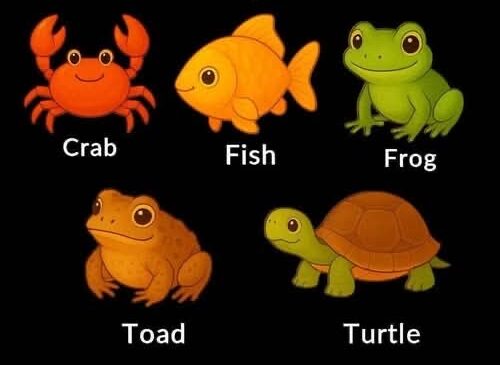
For instance, let us take a simple example of a row of cute little cartoon animals, such as a crab, a fish, a frog, a toad, and a turtle. While for many people it would seem pretty obvious at first glance which of these animals doesn’t really belong into this group, the truth is that different people perceive things differently, so no matter how awkward that sounds, the answers vary… a lot.

The type of animal that stands out to you, or the “odd one out,” can reveal a lot about the way your brain works. Are you looking at the type of environment they live in, the way they look, or perhaps the way they move?
Now comes the fun part: there is no right answer! Each of these animals have certain traits that can place them in the room with the rest of them, while one would appear as it simply doesn’t belong. The trick is to go with your intuition and choose without taking a lot of time.
Once you choose your odd animal out, take a look behind the scenes and and see what your choice reveals about your thinking patterns, problem-solving abilities, and even how your brain maps the world around you. This might seem like a simple test, but it can definitely reveal more than you anticipate.
If you picked the crab: the structural thinker

Noticing form and structure
If you went straight to the crab, it says you are attuned to form and structure, or that you are a “shapes and outlines” kind of person. This means you tend to focus on the physical characteristics before anything else.
In this lineup, the crab really stands out, and this is partly due to the fact that, whereas all of the other animals in this lineup are vertebrates and have a similar body type, the crab is a completely different kind of animal altogether. It is small, has a hard shell, is rounded in shape, has claws, and has multiple legs, basically, a complete structural anomaly.
What it says about you
This choice shows that you are a bottom-up thinker, meaning you approach problems in a logical and precise manner, and you are able to process a great deal of information in a short amount of time.
At work or in social situations, you are probably seen as that one person who brings order to the chaos. You are someone who appreciates systems, rules, and order because they provide you with a framework for making decisions.
Those around you probably think of you as a straight shooter, someone who cuts through confusion, makes things clear, and comes up with solutions. Your brain is wired to think in terms of order and consistency, and you are quick to point out whenever things don’t make sense for the sake of offering a better way to have the job done.
If you picked the fish: the big-picture thinker

Noticing connections and context
If the fish was your first pick, your mind is capable of noticing how things are related to one another. All the animals, except the fish, can be in both the water and on land. However, the fish is limited to the water. Your mind quickly picked up on this and focused on how it relates to its surroundings.
What it says about you
Choosing the fish indicates that you are a holistic thinker. You spot relations and and how things interact with each other, and how one single piece affects the whole. Your mind won’t stop asking, “How does this relate to everything else?”
This is what gives you an edge in life. Your mind is able to solve things creatively and in an intuitive manner because it is not limited to to the surface level. You can see the long-term effects and how everything is related.
You thrive in rather complex and dynamic surrounding. Your brain naturally focuses on relationships and balance, always aware that nothing exists in isolation.
If you picked the frog: the evolutionary empath

Awareness of change and transformation
In terms of biology, the frog is the epitome of transition. Unlike the rest of the animals in the category, which tend to retain the same physical blueprint from birth to maturity, the frog undergoes a complete transformation. It starts its life as completely aquatic, gill-breathing tadpole, and then transforms its entire anatomy to become a lung-breathing terrestrial adult. Choosing the frog means your brain prioritizes “becoming” over “being.”
What it says about you
You are a process-oriented thinker to whom the world is not composed of static objects but of stages of development. You have a natural sensitivity to the “trajectory” of things, whether it’s a project, a person, or your personal development.
In terms of your social and professional life, you are considered to possess a very high level of emotional intelligence. You pay attention on how experiences shape individuals and value progress over immediate results. You are a compassionate listener and mentor who values the journey as much as the destination. Your particular mental orientation to the world is centered on the concept of potentiality, or the hidden capacity for change in every given circumstance.
If you picked the toad: the nuance specialist

An eye for subtle differences
Most people would just group frogs and toads together without giving it a second thought. But since you chose the toad, your mind immediately went to the minute details that most people fail to notice. Toads have drier, more wart skin, a stockier built, and live more on land than their cousins the frogs. By choosing the toad, you disregarded the obvious classification on “amphibian” and zoomed in on what really makes it unique.
What it says about you
Making the choice about the toad shows you are a granular thinker who automatically picks up on the “details” that matter, the “signal” in the “noise.” While others are making general observations, you are the one who picks on the little quirks that characterize the situation.
At work and in social situations, you are the person that others turn to because you are the one who picks up what others miss. Whether it is looking at a project, reading between the lines in a conversation, or untangling a tricky social situation, you instantly focus on the details that matter the most. Your edge is your precision: you understand that the key to grasping the larger picture is to get the small stuff right.
If you picked the turtle: the systematic architect

Seeing order in the details
If the turtle was the first one that caught your eye, then your brain probably honed in on categorization. Although the other animals range from crustaceans to fish to amphibians, the turtle is the only reptile. Its shell—a completely integrated skeletal system—is like nothing else in this category. By choosing the turtle, you weren’t concerned with colors, shapes, or surface characteristics; you automatically looked for defining characteristics.
What it says about you
Choosing the turtle makes you a meticulous thinker. You don’t just rely on a hunch, but you like to classify, to know the rules, and to draw conclusions solely on facts. Tough problems don’t scare you easily, because you simply solve them one step at a time, by analyzing them and put them into logical pieces.
When it comes to your work and your social life, others turn to you for clarity and order. Other count on you to lay out a plan, check for inconsistencies, and make sure all the pieces are in the right place. You’re a thinker who likes to build on a foundation—you like to start with the basics and work from there. Your mind is always looking for a sound structure: all of your conclusions are based on logic and facts.
Conclusion
At the end of the day, this simple “odd one out” quiz isn’t designed to offer any kind of psychological evaluation. In fact, its purpose, which a rather fascinating by the way, is to celebrate the fact and each and every one of us perceives the world around us in a unique way. Five different individuals may glance at the same photo and come up with five completely different answers, each one correct in its own way. The beauty of perception is that that is rarely one “right” answer.
Some may see shapes and structures first, while other may see the environment and the entire eco system. Some may be wired to see categories or classifications, while others may see change or transformation. There are also those individuals who notice what everyone else might miss.
Please SHARE this article with your family and friends on Facebook.