
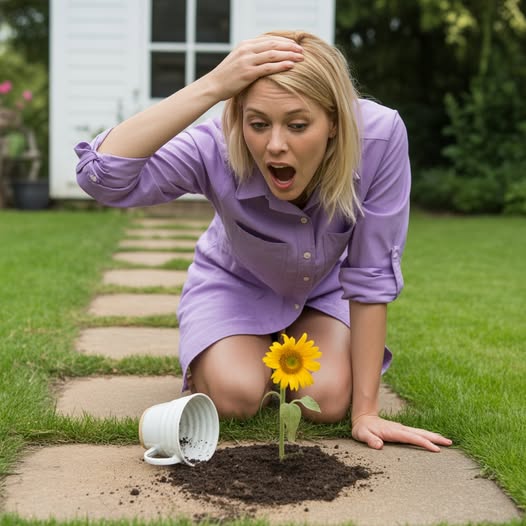
The pot slipped on a Tuesday.
That detail matters to me now, though I couldn’t tell you why. Not a significant day. Not an anniversary, not a holiday, not one of those dates that grief marks on your calendar whether you want it to or not. Just an ordinary Tuesday in late spring, warm and still, the kind of day that feels almost guilty in its pleasantness.
I had decided to repot the yellow flower.
It had been living in the same white ceramic pot for five years — ever since Daniel placed it on the garden path three weeks before he died, patting the soil down with both hands and saying, “There. Something that’ll outlast both of us.” He said things like that sometimes. Small, offhand observations that turned out to be true in ways he probably never intended.
The flower had outlasted him, at least.
I tended it the way you tend the last physical evidence of a person — carefully, almost superstitiously, convinced on some level that if the plant died, something final would happen. Some last thread connecting me to him would snap. So I watered it every other day, turned it toward the sun, talked to it sometimes in the evenings when the house got too quiet and the silence pressed in like something with weight.
My neighbor Margaret had commented once that it was the healthiest-looking flower she’d ever seen. “You’d think it was plastic,” she said, meaning it as a compliment. I thanked her and didn’t mention that I’d been keeping it alive through sheer force of stubborn love.
Five years.
The roots had outgrown the pot a while ago — I could see them beginning to press through the drainage holes at the bottom, pale and insistent. I’d been putting off the repotting for weeks, the way you put off anything that means disturbing something you’ve carefully preserved.
But that Tuesday, I finally went to the shed, found a larger pot and a bag of fresh soil, and carried everything out to the garden path. The morning was warm. Birds were doing something complicated in the maple tree. The world felt, for once, like a place I could manage.
I lifted the white pot with both hands.
It slipped.
That simple. No dramatic reason — my palms were slightly damp, the ceramic was smooth, and five years of careful handling had made me careless in the way that only safety can. The pot hit the tile path and shattered.
Soil scattered everywhere. The yellow flower toppled sideways, roots exposed, looking startled and vulnerable in the morning light.
I knelt down immediately, making the automatic sounds of apology that you make to plants when you’ve done something to them. I began gathering the soil with my hands, scooping it back toward the broken pieces.
That’s when I saw it.
Buried deep in the center of the root ball, packed into the base of the original soil — a small cloth bundle, neatly tied with a thin black thread.
I sat back on my heels.
My heart didn’t race. Not at first. It just — stopped, for a moment, the way a clock stops if you look at it too directly.
I picked up the bundle with both hands.
The fabric had yellowed, the way cloth yellows when it’s been in soil for years, pressed against damp earth through seasons of rain and sun and more rain. The thread was tight. Deliberately knotted by hands I recognized — careful, precise. Daniel had been an engineer. He tied everything like it was load-bearing.
I sat on the tiles surrounded by scattered soil and didn’t move for a long time.
In my hands was something my husband had buried in a pot he gave me, three weeks before he died. Something he had hidden in the one place he knew I would always tend. The one place he knew I would eventually look.
He’d been counting on me to find it.
It just took me five years.
I need to tell you about the night he died, because without it, none of the rest makes sense.
It was October. Late October, when the evenings come down fast and the air smells like rot and cold stone. It had been raining all day — that particular autumn rain that isn’t dramatic, just relentless, turning everything gray and making the world feel smaller than it is.
Daniel had gone to the store around seven. Bread, milk, the specific brand of instant coffee he insisted on even though I thought it tasted like regret. Ordinary things. He’d kissed me on the cheek on his way out, said he’d be twenty minutes.
He was home in fifteen.
I was in the kitchen when I heard it — a sound I have replayed so many times in my memory that I’m no longer certain I’m hearing the original version and not some reconstruction my brain assembled afterward. A dull, heavy thud. The kind of sound that doesn’t register as dangerous until your body is already moving.
I ran to the front of the house. I opened the door.
He was lying at the bottom of the porch steps. Face up. Eyes closed. The bag of groceries had split open beside him — bread gone flat against the wet tile, the coffee jar miraculously intact, a small mercy I noticed with the detached clarity that shock produces.
I screamed his name. I don’t remember getting to him. I was just suddenly kneeling beside him, my hands on his face, calling his name over and over in a voice I didn’t recognize as my own.
The ambulance came. The paramedics were efficient and quiet in the way that tells you they’ve done this many times. At the hospital, a doctor with tired eyes sat across from me in a waiting room and said the words that restructured my life: severe traumatic brain injury from the fall, I’m so sorry, there was nothing we could do.
Rain. Slippery steps. Darkness. The railing he’d been meaning to fix.
Everyone said it was an accident. The paramedics, the doctors, the police officer who took a brief statement and closed his notebook with the practiced finality of a man who has seen this before. Rain and slippery steps and bad luck and the terrible randomness of an ordinary evening.
I believed them.
Of course I believed them.
What else would I have believed?
The thread came undone slowly.
I sat on the garden path with the bundle in my lap for a long time before I opened it. The sun moved. A cloud crossed over it and the warmth went briefly gray. The yellow flower lay on its side in the scattered soil, patient as ever.
Inside the cloth were three things.
A bank card. The kind that comes without a name, a prepaid card loaded with an amount I wouldn’t know until I checked. A flash drive, small and black, the cheap kind you buy in multipacks. And a note, folded in thirds, on paper I recognized — the pale blue notepaper Daniel used for everything, from grocery lists to birthday messages.
His handwriting. All loops and sharp angles, the handwriting of someone who spent his days writing on whiteboards and in margins.
If you’re reading this, it means I didn’t get the chance to explain everything.
The money on the card is for emergencies — for you, if something goes wrong. I hope you never need it.
I feel like I’m being watched. I don’t want to frighten you with this, and I hope I’m wrong. But if something happens to me, please don’t accept that it was an accident.
I wasn’t planning to die.
I read it three times.
The birds in the maple tree were still doing their complicated thing. Somewhere down the street, a lawnmower started up. The world continued its business with total indifference to the fact that my hands were shaking and the man I’d spent five years mourning as a victim of wet tiles and bad timing had apparently spent the last weeks of his life afraid.
I gathered the note and the card and the flash drive. I left the broken pot and the scattered soil and the yellow flower where they were. I went inside and sat at the kitchen table and put the flash drive into my laptop.
The video opened without a title.
Daniel was sitting in his car — I recognized the seats, the specific crack in the dashboard on the passenger side that he’d been meaning to have fixed for two years. He was parked somewhere I didn’t recognize, somewhere with trees visible through the windshield, their leaves the particular yellowed green of early autumn.
He looked tired. That was the first thing I noticed, because Daniel had always looked energetic — that slightly restless, forward-leaning quality of someone whose brain moved faster than conversations usually allowed. In the video, the restlessness was still there, but it had curdled into something else. He kept glancing toward the passenger window. His hands were laced together on the steering wheel, then unlaced, then laced again.
He spoke quietly. He spoke like a man who was aware that sound traveled.
He told me about the company.
He’d been working there for four years when it started — or rather, when he started noticing. Small things at first: vendor payments that didn’t match the contracts, transaction dates that didn’t align with project timelines. An engineering firm shouldn’t have had reason to run money through the number of shell companies that appeared in the accounts he’d accidentally been given access to during a system migration.
He’d gone to his direct manager. His manager had smiled and said there was probably a simple explanation and he’d look into it.
Three days later, a VP he’d never spoken to before invited him to lunch and spent an hour talking, warmly and conversationally, about the importance of discretion in corporate environments. About how people who understood discretion tended to thrive. About how people who didn’t — well, business could be complicated.
Daniel had understood.
He’d kept his head down for two weeks, running calculations. He was methodical; it was why he was good at his job. He copied files. He documented dates. He built a case the way he built load calculations — piece by piece, weight-bearing, nothing included that couldn’t support its own evidence.
Then he’d contacted the prosecutor’s office.
A meeting had been arranged for the following Thursday.
On the Tuesday before that Thursday, he’d come home from work and noticed a car parked across the street. Dark, tinted windows. He wouldn’t have thought anything of it — cars parked there regularly — except that the same car had been there Monday morning when he left and Wednesday evening when he returned. Same position. Same plates.
On the Thursday of his meeting, it wasn’t there.
After the meeting — which he described in the video as “preliminary, they need more time to verify” — it was back.
He spoke directly into the camera at the end of the video.
“I’m going to record everything. I’m going to make copies of everything. I’m putting together a second package — a backup — in case something happens to me before this goes through.” He paused, glancing toward the window again. “I know this probably sounds paranoid. I hope it sounds paranoid. I hope I look back at this in a year and laugh at myself.” Another pause. “But I want you to know that I knew what I was doing. I knew the risk. I chose it because I thought it was right. And if something happens before I can finish — please don’t let them call it an accident.”
The video ended.
I sat at my kitchen table in the warm morning of an ordinary Tuesday and felt the five years I’d spent grieving quietly rearrange themselves into something jagged and entirely different.
I thought about the night he died.
I had replayed it so many times over the years — the sound, the groceries, his face — that the memory had worn smooth from handling, like a stone you carry in your pocket until it loses its edges.
But now I turned it over and looked at the underside.
He had been lying at the bottom of the steps, not the top. Three steps down from the door. If you slipped at the top, on the wet tiles of the top landing, momentum would take you forward and down, but you would likely land partway down, not at the bottom. At the bottom meant something different. At the bottom meant either the railing had failed completely, or — or he hadn’t been at the top when he fell.
Or when he was pushed.
The railing. We’d talked about it for months, an ongoing low-level negotiation about when to call someone, how much it would cost, whether we could do it ourselves. I had tested it the week before he died and it had been loose but solid — workable, functional, not dangerous. Two days after the funeral, when Margaret helped me with the house, I’d noticed the railing was gone entirely. I’d assumed the police or paramedics had removed it during the response.
I had never thought to ask.
I had never thought to ask anything, because grief is not an investigative state. Grief is a state of pure absorption, where the mind takes the official version and holds it like a life raft because the alternative — that the official version is wrong, that there is no raft, that you are in open water — is unthinkable.
And then I remembered the sound.
The night he died, after the ambulance left, I had stood on the porch in the rain, unable to go inside. At some point — I didn’t know when — I’d heard a car engine start. A sharp revving sound, sudden and fast, the sound of someone leaving in a hurry. I’d barely registered it.
I registered it now.
I called the police at 11:42 in the morning.
Not because I thought they would immediately believe me — I had no illusions about walking in with a flash drive and having officers leap to action. I called because Daniel’s note said call the police, and because somewhere in the evidence on that drive was documentation he’d been carefully, precisely building toward exactly this moment.
He’d been an engineer. He’d known that structures needed to be load-bearing.
The officer who took my initial call was a young woman named Daria, patient and careful in a way that suggested she’d had training in exactly this kind of situation — the grieving widow who has developed a theory. I didn’t blame her for the professional gentleness. I gave her the facts in order: the pot, the bundle, the note, the video, the bank card, the flash drive.
She asked me not to touch anything else and to expect a detective within the hour.
Detective Hana arrived in fifty-two minutes. She was compact and quiet, with the alert stillness of someone who listened before she spoke. She went through the flash drive with me — through the video, then through the attached folder of documents Daniel had labeled simply Backup.
The folder contained 140 files.
Transaction records. Shell company registrations. Email correspondence involving names I didn’t recognize. A timeline he’d assembled, dated and annotated in his meticulous handwriting, of every suspicious event he’d observed over eighteen months. Copies of the documents he’d taken to the prosecutor’s office. Photographs — taken discreetly through his car window — of the dark vehicle he’d described.
And at the bottom of the folder, a single file labeled Railing.
Inside were three photographs, time-stamped the morning before he died.
The first showed our porch railing, intact, secure.
The second showed a close-up of the bolts where the railing met the post — intact, no corrosion, properly seated.
The third photograph was taken at an angle I didn’t recognize at first. Then I understood: it was taken from the street, looking up at our porch. You could see the railing in the background, and in the foreground, slightly blurred but visible, the rear end of a dark car with tinted windows.
He’d known they were watching. He’d photographed the railing to document its condition. He’d known that if something happened to him, the state of that railing would matter.
He’d been building this case up to the last morning of his life.
Detective Hana was quiet for a long time after we went through the last file. Then she closed the laptop carefully, the way you close something that deserves careful handling.
“We’re going to need to take all of this,” she said.
“I know,” I said.
“And we’re going to need to reopen the original investigation.”
The words landed in the kitchen like something physical.
Reopen the original investigation.
Five years. Five years of rain and slippery steps and bad timing and the randomness of an ordinary evening. Five years of a closed notebook.
“He knew,” I said. My voice came out steadier than I expected. “He knew something might happen and he spent his last weeks making sure I could find this.”
Detective Hana looked at me carefully. “It appears that way, yes.”
“He hid it in the one place he knew I’d tend for years,” I said. “The flower. He knew I’d never get rid of it. He knew that eventually — when I was ready — I’d repot it. That I’d find it.”
She nodded slowly.
“He trusted you to look,” she said.
The investigation that followed was neither quick nor clean.
That’s what television gets wrong about justice — the neat resolution, the satisfying final act where everything locks into place and the credits roll. Real investigations are slow and bureaucratic and full of delays that feel like small cruelties when you’re living through them.
But Daniel had been thorough.
The documents on the flash drive were exactly what they appeared to be — a carefully assembled record of financial fraud, money laundering through shell companies, and the slow, methodical documentation of a man who had understood what he was walking into and had prepared accordingly. The prosecutor’s office confirmed that the preliminary meeting he’d described had taken place. The case file, suspended after his death, was reopened.
The original accident investigation was re-examined.
The railing had been removed from the property shortly after the funeral — not by police, as I’d assumed, but by persons unknown. A neighbor two houses down, an elderly man who spent most evenings at his front window, recalled seeing a car parked near our house on the night of the accident. Dark. Tinted windows. He’d noted it because it was parked at an odd angle, too far from the curb. He hadn’t thought to mention it at the time because no one had asked.
I thought about all the things that were never asked because the official version was so clean, so complete — rain and darkness and a wet step — that there had seemed to be no reason to look further.
Formal charges came fourteen months after that Tuesday in the garden.
Three men from Daniel’s former company. A network of financial crimes across multiple jurisdictions. Obstruction charges, conspiracy, and at the center of it — a charge that took the prosecutor’s careful, deliberate language to describe but that meant, in plain terms, that my husband had not slipped.
I was not in the courtroom for the verdict. My lawyer — a quiet woman named Sandra who wore sensible shoes and said exactly what she meant — had advised me that being present would be difficult, and that the outcome did not require my witness to be real.
She texted me three words: Guilty on all.
I was in the garden when my phone buzzed. Sitting on the path beside the yellow flower, which I’d repotted in a larger white ceramic pot shortly after Detective Hana had returned the original evidence. The soil was fresh. The roots were spreading out the way roots do when they finally have room.
I read Sandra’s text three times.
Then I set my phone on the tile beside me, put both hands in my lap, and let myself cry.
Not the quiet, controlled grief of five years of maintaining normalcy. Not the autopilot grief of waking up and pretending and going to sleep with the same emptiness. Real crying, ugly and uncontrolled, the kind that comes when the story you’ve been telling yourself turns out to have an entirely different ending than you thought.
I hadn’t lost him to rain and bad luck and the randomness of a wet step.
I’d lost him because he was the kind of man who saw something wrong and refused to look away from it. Who spent his last weeks quietly, methodically building the case that would outlast him. Who found a way to reach forward through time and hand me the truth, hidden in the thing he knew I’d never stop tending.
He had trusted me to look.
He had trusted me to be ready, eventually, when I was strong enough.
He had trusted me to finish it.
The bank card, it turned out, had eleven thousand dollars on it.
Daniel had loaded it over several months — small amounts, irregular intervals, the kind of pattern that doesn’t attract attention. He’d thought of everything. He’d thought even of the practical aftermath — of me, alone, needing money for lawyers and investigators and whatever came next.
I donated half of it to a whistleblower advocacy organization I found after months of research. Organizations that do the work Daniel had believed in — supporting people who see something wrong and refuse to look away.
The other half went into a fund for our daughter.
I haven’t mentioned her yet. She was eight weeks old when Daniel died. She has no memory of him — just the photographs I’ve kept framed around the house, the stories I tell her, the careful way I describe a man who was kind and precise and believed that doing the right thing mattered even when it was costly.
She’s five now. She helps me water the flower.
Last week, she asked me where the white pot came from.
“Your father gave it to me,” I said.
She considered this with the solemn gravity that five-year-olds bring to important information. “Did he know you would like it?”
“He knew I would take care of it,” I said.
She nodded, satisfied with this, and tipped the watering can carefully over the soil the way I’d shown her — slowly, at the edges, giving the roots time to absorb it.
She has his hands. That same careful precision, even at five. The way she does things like they matter.
I watched her tend it and thought about what he’d known: that I would keep this thing alive, that I would eventually be ready to disturb it, that I would find what he’d left for me and do what needed to be done.
He’d been right about all of it.
He usually was.
The yellow flower has bloomed every spring for five years. I don’t know what variety it is — Daniel bought it from a market stall and the tag was lost, and I never got around to identifying it, too busy just keeping it alive to think about names.
It bloomed again this spring. Bright yellow, almost aggressive in its cheerfulness, the way certain flowers are, indifferent to weather and circumstance and the complicated human drama happening around them.
Something that’ll outlast both of us, he’d said, patting the soil down.
He was right about that too.
He’d planted the truth right alongside it, buried in the same soil, protected by the same roots, tended by the same hands.
All he had to do was trust me to find it.
And I did.
This work is inspired by real events and people, but it has been fictionalized for creative purposes. Names, characters, and details have been changed to protect privacy and enhance the narrative. Any resemblance to actual persons, living or dead, or actual events is purely coincidental and not intended by the author.
The author and publisher make no claims to the accuracy of events or the portrayal of characters and are not liable for any misinterpretation. This story is provided “as is,” and any opinions expressed are those of the characters and do not reflect the views of the author or publisher.


